Pet urine stains are one of the hardest carpet problems to fully fix. That’s because urine doesn’t just sit on the surface. It soaks into the fibers, seeps into the carpet pad, and leaves behind crystals that keep releasing odor long after the wet spot dries. Regular cleaners mask the smell for a day or two. Enzyme cleaners actually eliminate the source.
This guide covers exactly how enzyme treatments work on pet urine, which products are worth using, how to apply them correctly, and when the damage has gone too far for a DIY fix.
Key Takeaways
- Uric acid crystals are the real problem. They bond to carpet fibers and reactivate with humidity, releasing odor again and again until they’re fully broken down.
- Enzyme cleaners digest uric acid. They use biological catalysts to break uric acid molecules into carbon dioxide and water, which then evaporate.
- Saturation is critical. The enzyme solution must reach the same depth the urine did, including the pad, or the odor will return.
- Dwell time matters more than scrubbing. Enzymes need 10 to 30 minutes of contact time to work. Blotting too soon stops the process.
- Not all products are equal. Bacterial-enzyme formulas outperform oxidizer-based sprays for deep urine odor elimination.
- Professional treatment is necessary when urine has spread across multiple spots, penetrated the subfloor, or the odor persists after two DIY attempts.
What Makes Pet Urine So Hard to Remove from Carpet?

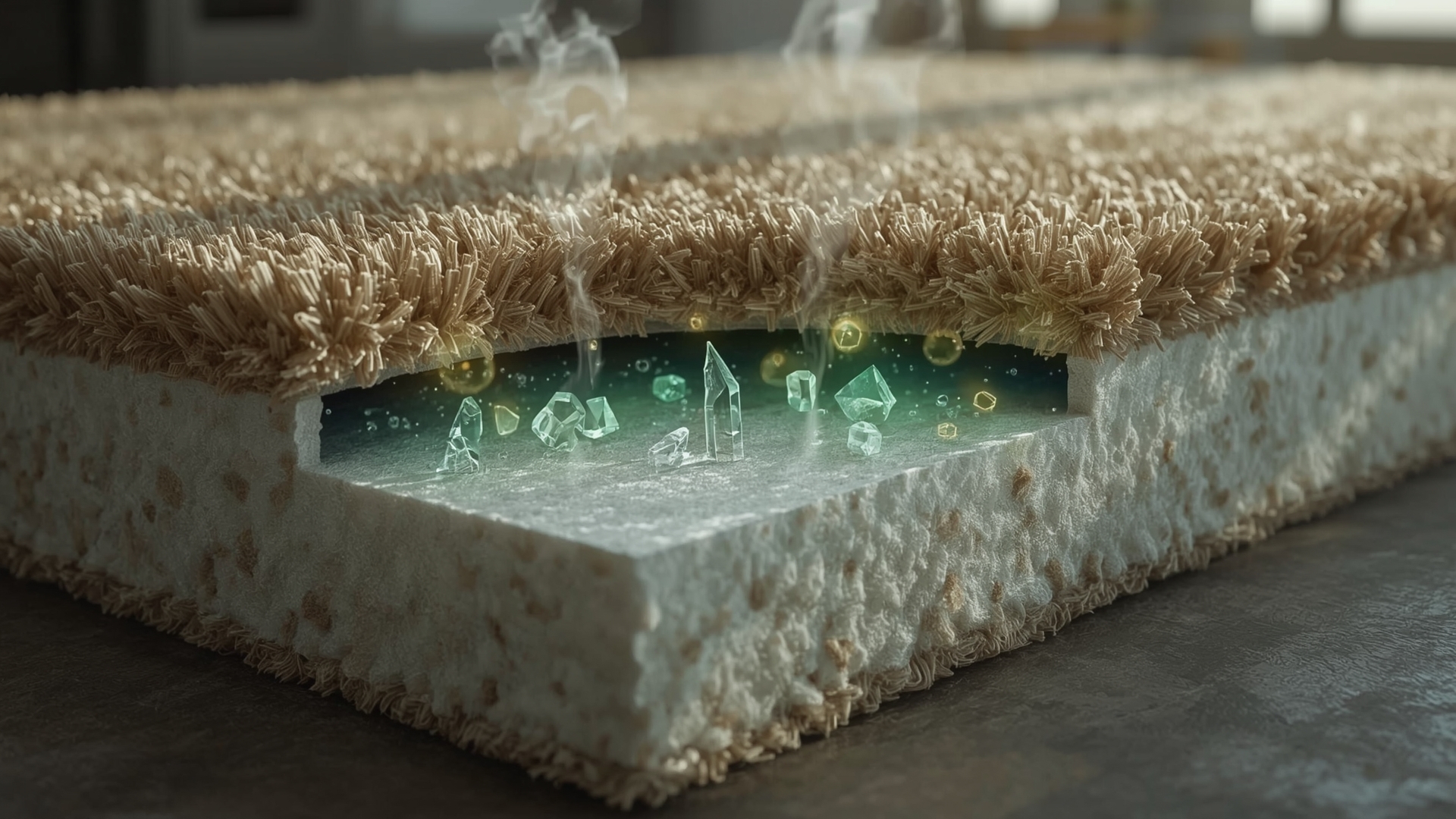
Quick Answer: Pet urine contains uric acid, which forms crystals that bond tightly to carpet fibers. These crystals don’t dissolve in water. They reactivate with moisture and humidity, releasing odor repeatedly until a biological enzyme breaks the molecular structure apart.
Fresh pet urine is mostly water, ammonia, creatinine, and uric acid. The water evaporates quickly. The ammonia causes that sharp initial smell. But uric acid is the long-term problem.
Uric acid molecules form crystals as they dry. These crystals bond to carpet fibers at a chemical level. Water alone can’t dissolve them. Steam can temporarily reduce the smell, but it also rehydrates the crystals, often making the odor stronger in the short term.
Worse, urine doesn’t stay in one place. It spreads as it soaks down through the carpet face, the backing, and into the pad below. A wet spot that looks like a quarter on the surface can spread to the size of a dinner plate by the time it reaches the pad. This hidden spread is why spot-treating the surface rarely works long-term.
Why Does the Smell Come Back After Cleaning?
The smell returns because the uric acid crystals weren’t removed. Cleaning solutions that don’t contain enzymes can lift surface debris and reduce the smell temporarily. But when humidity rises, or when the area gets wet again during cleaning, the crystals reactivate and release odor molecules back into the air.
This cycle repeats indefinitely until the crystals are chemically broken down. That’s exactly what enzyme treatments are designed to do.
How Do Enzyme Cleaners Actually Break Down Uric Acid?
Quick Answer: Enzyme cleaners contain biological proteins called enzymes that act as catalysts. They attach to uric acid molecules and break them into carbon dioxide and water. Those byproducts evaporate, eliminating the odor source rather than covering it up.
Enzymes are proteins that speed up chemical reactions. In pet urine cleaners, the key enzyme is uricase. Uricase specifically targets uric acid and catalyzes (speeds up) its breakdown into smaller, harmless molecules.
Most enzyme-based pet cleaners also contain live bacteria cultures. These bacteria produce more enzymes as they work, which extends and deepens the cleaning action. This is why bacterial-enzyme formulas tend to outperform simple enzyme sprays: they’re self-reinforcing as long as conditions stay favorable (moist, room temperature, not exposed to harsh chemicals).
The end products of the reaction are carbon dioxide and water. Both evaporate. There’s no residue left behind, and no odor molecules remain once the process completes.
What Enzymes Are in Pet Urine Cleaners?
Most pet urine enzyme formulas target multiple components of urine, not just uric acid. Here’s what a complete formula typically contains:
- Uricase: Breaks down uric acid crystals into soluble compounds
- Protease: Digests protein-based residue from urine
- Amylase: Breaks down any starch or carbohydrate compounds in organic waste
- Lipase: Targets fatty residue that can bind odor to fibers
A product that targets all four components will outperform one that only lists “enzyme formula” without specifics.
What Are the Different Types of Pet Urine Enzyme Products?
Quick Answer: Pet urine enzyme products fall into three main types: bacterial-enzyme formulas, oxidizer-based sprays, and enzyme concentrate solutions. Bacterial-enzyme formulas are the most effective for deep odor elimination. Oxidizers work faster but don’t fully remove uric acid crystals.
| Product Type | Active Agent | Dwell Time | Effective Depth | Best For | Limitations |
|---|---|---|---|---|---|
| Bacterial-Enzyme Formula | Live bacteria + uricase, protease, lipase | 10 to 30 minutes | Fiber + backing + pad | Deep, set-in odors | Slower acting; bacteria need moisture and warmth |
| Oxidizer-Based Spray | Hydrogen peroxide or sodium percarbonate | 5 to 10 minutes | Fiber surface only | Fresh stains, surface brightening | Can bleach dark carpets; doesn’t break uric acid crystals |
| Enzyme Concentrate | High-potency enzyme blend, diluted before use | 15 to 45 minutes | Full depth when properly diluted and applied | Heavy contamination, multiple spots | Requires correct dilution ratio; overdilution reduces effectiveness |
| Enzyme Foam | Enzyme formula in aerated suspension | 10 to 20 minutes | Fiber only | Surface-level odors and light staining | Poor penetration on thick or padded carpet |
How Do You Apply Enzyme Cleaner to Pet Urine in Carpet?

Quick Answer: Blot up fresh urine first, then saturate the affected area with enzyme cleaner to match the depth of the urine. Let it dwell for 10 to 30 minutes without disturbing it. Blot dry, then allow the area to air dry completely before assessing the result.
Step 1: Remove as Much Urine as Possible First
If the urine is fresh, blot the area with a clean white cloth or paper towels. Press firmly and work from the outside edge toward the center to avoid spreading. Don’t rub. Rubbing pushes urine deeper into the fibers and spreads the contamination zone.
Keep blotting until no more moisture transfers to the cloth. For dried urine, skip to step two since there’s nothing left to blot.
Step 2: Identify the Full Contamination Zone
The visible stain is almost always smaller than the actual contaminated area. Use a UV blacklight (also called a urine detection light) in a darkened room. Pet urine fluoresces under UV light, showing the real spread of contamination. Treat the entire glowing area, not just the visible stain.
Step 3: Saturate the Area with Enzyme Cleaner
Apply enough enzyme solution to match the depth the urine reached. If the urine soaked into the pad, the enzyme solution must reach the pad. This usually means applying more product than you expect. A common mistake is light misting when full saturation is needed.
For thick carpets or large contamination zones, apply the solution slowly so it penetrates instead of running off to the sides. Some professionals use a weighted towel placed on top of the treated area to hold the solution in contact with the fibers during dwell time.
Step 4: Allow the Full Dwell Time
This is the step most people get wrong. Dwell time is the period the enzyme solution sits undisturbed on the carpet. Enzymes need time to attach to uric acid molecules and complete the chemical breakdown. Cutting dwell time short means incomplete treatment.
Standard dwell time is 10 to 30 minutes for consumer products. Professional-strength enzyme concentrates may require up to 45 minutes. Check the product label, and don’t rush this step.
Step 5: Blot and Extract
After dwell time, blot the area again with clean towels. If you have a wet/dry vacuum, use it to extract as much moisture as possible. Extracting the solution also removes the broken-down uric acid byproducts along with any remaining bacteria.
Step 6: Dry Completely Before Evaluating
Don’t judge results while the carpet is still wet. The area must dry completely, which can take 6 to 24 hours depending on carpet thickness, ambient temperature, and humidity. Use a fan to speed drying. Once fully dry, use the UV blacklight again to check whether the contamination is gone.
If fluorescence remains, repeat the treatment. One application may not be enough for heavy or long-standing contamination.
What Factors Affect How Well Enzyme Treatment Works?
Quick Answer: Temperature, moisture level, dwell time, contamination depth, and prior cleaning products all affect enzyme treatment results. Enzyme bacteria need room-temperature conditions and moisture to work. Previous use of vinegar, bleach, or steam can neutralize or kill the enzyme cultures.
| Factor | Optimal Condition | What Goes Wrong Outside This Range |
|---|---|---|
| Temperature | 65°F to 85°F (18°C to 29°C) | Cold slows enzyme activity; heat above 120°F kills bacteria |
| Moisture Level | Area should be damp, not soaking | Too dry = enzymes can’t move; too wet = dilutes enzyme concentration |
| Dwell Time | 10 to 45 minutes depending on product | Blotting too early stops the reaction mid-process |
| Prior Cleaning Products | None, or water only | Vinegar, bleach, and quaternary disinfectants neutralize enzymes |
| Contamination Age | Fresh stains respond in 1 treatment | Set-in stains from weeks or months may need 2 to 3 treatments |
| Carpet Fiber Type | Synthetic nylon or polyester | Wool and natural fibers require lower-pH enzyme formulas to avoid damage |
Can You Use Enzyme Cleaner on Any Type of Carpet?
Quick Answer: Most enzyme cleaners are safe for synthetic carpets like nylon and polyester. Wool, silk, and other natural fiber carpets need pH-neutral enzyme formulas. Always test a small hidden area first. High-pH enzyme products can damage protein-based natural fibers permanently.
Synthetic carpet fibers like nylon, polyester, and olefin (also called polypropylene) can handle most standard enzyme formulas without risk of damage. These fibers are chemically stable and don’t react negatively to enzyme activity.
Wool carpet is different. Wool is a protein-based fiber. Some enzyme blends, particularly those with high protease concentrations, can break down wool fibers the same way they break down urine proteins. Always use a formula specifically labeled as wool-safe, and test on a hidden area before full application.
Berber carpet presents a different challenge: the looped construction traps moisture and slows drying. Oversaturation on Berber can lead to backing delamination, where the carpet layers separate due to extended moisture exposure.
When Should You Call a Professional Instead of Using DIY Enzyme Treatment?
Quick Answer: Call a professional when urine has spread to multiple areas, soaked into the subfloor, or when two rounds of DIY enzyme treatment haven’t eliminated the odor. Professionals use higher-concentration enzyme formulas and extraction equipment that reaches deeper than consumer products.
Signs the Damage Has Gone Beyond DIY Treatment
- More than 3 to 4 urine spots identified under UV light across the carpet area
- Odor persists after two full enzyme treatments with proper dwell time and saturation
- The subfloor is affected (visible staining on concrete or wood underneath when carpet edge is lifted)
- The carpet pad is heavily saturated and cannot be dried or treated from above
- The carpet has a strong ammonia smell even in dry conditions with no humidity
What Professionals Do Differently
Professional carpet cleaners use enzyme concentrates with higher bacterial cultures than consumer products. They apply with pressurized injection systems that force the solution into the pad without oversaturating the face fibers. They then extract with truck-mounted or commercial wet-vac systems that pull far more moisture than a home wet/dry vacuum.
In severe cases, professionals will pull back the carpet, treat the pad and subfloor separately, replace the pad if needed, and re-treat the carpet backing before reinstalling. This level of access is impossible with a spray bottle and paper towels.
| Scenario | DIY Enzyme Treatment | Professional Treatment |
|---|---|---|
| Single fresh urine spot, caught within hours | Effective in 1 to 2 treatments | Not necessary |
| Dried urine spot, 1 to 2 days old | Effective in 2 to 3 treatments | Optional for faster results |
| Multiple old spots, 1 to 4 weeks old | Partially effective; may not reach pad | Recommended |
| Heavy contamination across large area | Insufficient penetration and extraction | Required |
| Subfloor affected | Cannot access subfloor | Required; pad replacement likely |
What Are Common Mistakes That Make Enzyme Treatment Fail?

Quick Answer: The most common enzyme treatment mistakes are using too little product, not waiting long enough for the dwell time, using a prior cleaning product that kills the enzyme cultures, and treating only the visible stain instead of the full contamination zone identified by UV light.
Mistake 1: Under-Saturating the Treated Area
The enzyme solution must reach every surface the urine touched. If the urine reached the pad, a light surface spray is completely ineffective on the odor source. Match your application volume to the contamination depth.
Mistake 2: Using Vinegar Before Enzyme Cleaner
Vinegar is widely suggested as a home remedy for pet urine. It neutralizes ammonia smell temporarily. But vinegar is acidic, and many enzyme cultures are sensitive to low-pH environments. Applying vinegar before enzyme treatment can reduce or eliminate the enzyme’s effectiveness. If you’ve used vinegar, rinse the area thoroughly with water and let it dry before applying enzyme cleaner.
Mistake 3: Applying Heat Too Soon
Heat denatures (destroys the structure of) enzyme proteins. Using a steam cleaner or hot water on the area before or during enzyme treatment will kill the enzyme cultures and stop the reaction. Keep the area at room temperature during and after application until the process is complete.
Mistake 4: Treating Only the Visible Stain
UV light routinely reveals that the contamination zone extends 2 to 4 inches beyond what’s visible to the naked eye. Treating only the visible stain leaves active uric acid crystals in the surrounding area, and the odor returns.
How Long Does Enzyme Treatment Take to Fully Work?
Quick Answer: Fresh urine spots treated correctly show results within 24 hours after full drying. Set-in stains may require 2 to 3 treatments over several days. Complete odor elimination from heavy contamination, including pad-level urine, can take 5 to 10 days with repeated treatments.
Enzyme treatment is not a one-spray solution for old or deep urine contamination. The biological process takes time. Bacterial cultures continue working as long as the area stays moist and at room temperature, which is why some professionals recommend covering the treated area with plastic sheeting for 24 hours to extend dwell time for severe cases.
Check results only after the carpet is fully dry. Smell-testing a damp carpet doesn’t give accurate results because residual moisture can mimic urine odor temporarily.
Frequently Asked Questions
Does enzyme cleaner remove urine stains or just the odor?
Enzyme cleaners primarily target odor by breaking down uric acid. They also help lift some staining, but old urine stains may leave a yellow discoloration in carpet fibers that requires a separate stain treatment. Address odor first, then staining if discoloration remains.
Is enzyme cleaner safe to use around pets and children?
Most consumer enzyme cleaners are non-toxic once dry. Keep pets and children off the treated area during application and dwell time. Once the carpet is fully dry, the area is safe. Check the product label for any specific cautions about direct contact during treatment.
Can enzyme cleaner work on cat urine as well as dog urine?
Yes, enzyme cleaners work on both cat and dog urine. Cat urine contains higher concentrations of uric acid and additional sulfur-containing proteins, which makes it more pungent. Cat urine often requires a longer dwell time and may need more than one treatment compared to dog urine.
Does the carpet pad always need to be replaced after pet urine damage?
Not always. Light to moderate contamination can sometimes be treated from above with sufficient enzyme saturation and extraction. Heavy or long-term contamination usually saturates the pad beyond what surface treatment can reach. A professional can assess pad condition by lifting a corner of the carpet to inspect it directly.
Will enzyme cleaner discolor or bleach carpet?
Standard enzyme formulas won’t bleach or discolor most carpets. Oxidizer-based products that contain hydrogen peroxide can lighten dark carpet fibers. Always test any product on a hidden area before full application, especially on darker or natural fiber carpets.
Can enzyme cleaner prevent pets from re-marking the same spot?
Eliminating the uric acid scent removes one of the primary triggers that draws pets back to the same location. If the odor is fully eliminated, pets are much less likely to re-mark that area. However, some pets mark for behavioral reasons unrelated to scent, in which case enzyme treatment alone won’t stop re-marking.