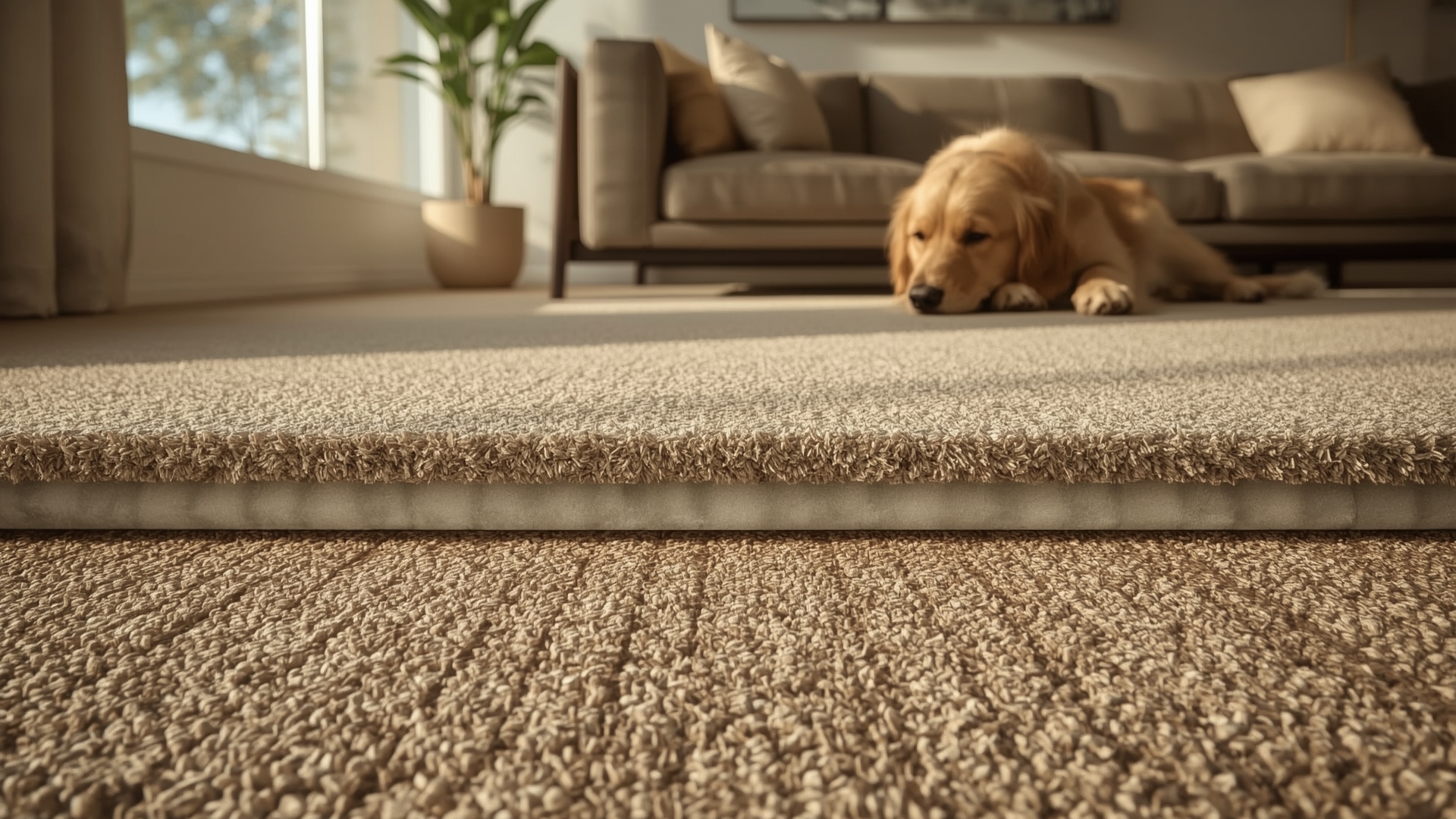
Pet urine does something most homeowners don’t expect. It soaks straight through the carpet fibers, through the backing, and deep into the pad underneath. The carpet on top might look clean after treatment. But the pad below can hold months or years of urine that keeps releasing odor long after you’ve cleaned the surface.
Knowing when to replace the pad — not just the carpet — is the difference between solving the odor problem and chasing it. This guide covers every signal that tells you the pad is past saving, how professionals evaluate pad condition, what replacement costs look like, and which pad materials hold up best when you have pets.
Key Takeaways
- The pad absorbs more urine than the carpet above it. A single incident can soak 2 to 3 times deeper into the pad than the visible stain suggests.
- Odor that returns after cleaning is the clearest sign of pad saturation. Surface cleaning cannot reach uric acid crystals locked inside a saturated pad.
- Professionals use moisture meters, UV lights, and physical inspection to confirm whether a pad is salvageable or beyond treatment.
- Replacing just the pad costs $1 to $2 per square foot for materials, significantly less than full carpet replacement at $3 to $7 per square foot installed.
- Closed-cell foam and rubber pads resist urine absorption far better than standard rebond pads, which act like a sponge.
- Subfloor condition must be checked before new pad is installed. Urine that soaked through the pad may have stained or warped the subfloor below.
How Does Pet Urine Damage Carpet Pad?
Quick Answer: Pet urine soaks through carpet fibers and backing into the pad, where it pools and spreads outward. As it dries, uric acid crystals form inside the pad’s foam structure. These crystals reactivate with humidity, releasing ammonia and odor repeatedly.
The pad sits between your carpet and the subfloor. Its job is cushioning and insulation. But its structure — usually open-cell foam or compressed fiber — acts like a sponge. Liquid flows in easily and drains out slowly.
When a pet urinates on carpet, the liquid spreads outward as it descends. A spot that looks 6 inches wide on the carpet surface may have spread to 12 or 18 inches wide inside the pad. The urine pooling at the pad-to-subfloor interface sits in contact with both surfaces for extended periods.
Uric acid, the compound responsible for persistent pet odor, isn’t water-soluble in its crystallized form. Standard cleaning agents and even many enzyme cleaners can’t penetrate a thick, saturated pad effectively enough to break down every crystal. This is why odor persists even after professional surface cleaning.
What Happens to Pad Structure Over Time With Repeated Incidents?
Each urine event adds more crystal buildup inside the pad’s cell structure. Over months or years, the pad also begins to break down physically. The foam loses its resilience, develops dark discoloration, and in humid climates, supports mold and bacterial colonies.
A pad that has absorbed multiple incidents across a large area is no longer functioning as cushioning, either. It compresses unevenly, which you can feel underfoot as soft or spongy spots that differ from the rest of the floor.
What Are the Signs Your Carpet Pad Needs Replacing?
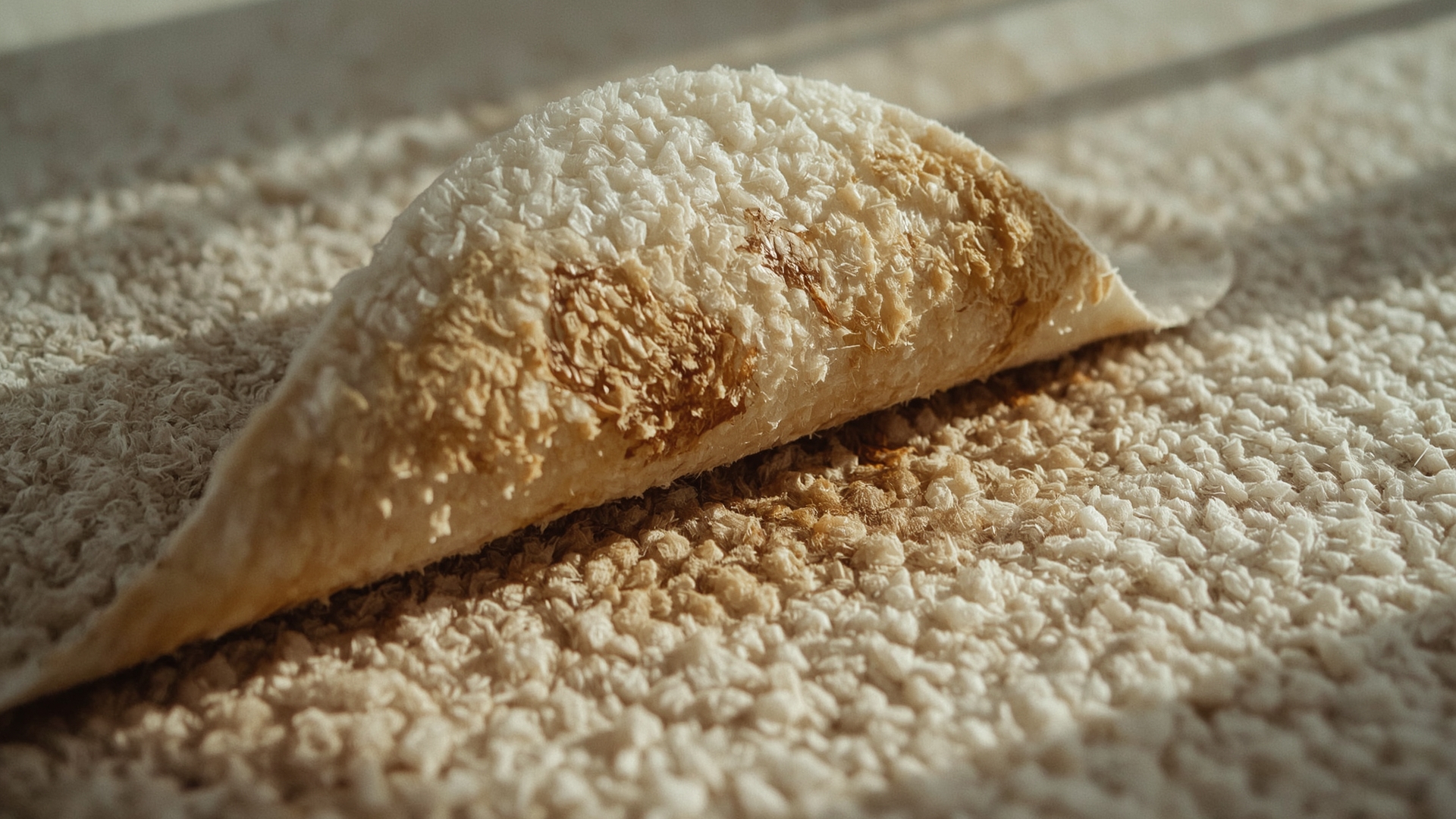
Quick Answer: The main signs are persistent odor after cleaning, spongy or uneven texture underfoot, visible dark staining when carpet is pulled back, and wet or damp pad in dry conditions. Any one of these signals pad saturation that surface treatment won’t fix.
Persistent Odor After Professional Cleaning
This is the most reliable indicator. If a carpet has been professionally cleaned and treated with enzyme products, and the odor returns within days to two weeks, the source is almost certainly the pad. Enzyme treatments applied to the surface cannot fully penetrate a thick, compressed pad to reach every uric acid crystal.
The odor pattern also tells you something. If it worsens during humid weather or after mopping nearby hard floors, that’s reactivation. Humidity dissolves uric acid crystals and releases ammonia gas. A pad full of crystals will keep triggering this cycle indefinitely.
Spongy, Soft, or Uneven Texture Underfoot
Run your hand or foot across a suspect area. A healthy pad feels consistently firm and resilient. A urine-saturated pad feels noticeably softer, sometimes almost mushy in the worst spots. This physical change happens because repeated wetting and drying breaks down the foam’s cell walls.
You may also notice the carpet feels different in that zone compared to adjacent areas. That tactile difference is a sign the pad’s structural integrity has failed.
Dark Staining or Discoloration When Carpet Is Pulled Back
Pulling back a corner of the carpet in a suspected area reveals the pad directly. A healthy pad is typically white, gray, or cream-colored with uniform texture. A damaged pad shows yellow, brown, or dark staining, sometimes with visible crystalline residue. In severe cases, you may see black or green discoloration, which indicates mold growth.
The carpet backing itself may also show staining from urine wicking back up from the pad. If the backing is stained, the pad below almost certainly is too.
Wet or Damp Pad Without a Recent Spill
If you press down on carpet in a dry room and feel moisture, or if the pad feels damp when you lift the carpet, that moisture is likely urine that never fully dried out. This happens in high-volume areas where incidents occurred frequently and the pad never had time to dry between events.
Constant moisture in the pad creates conditions for mold and bacterial growth, which adds a second odor source on top of the uric acid problem.
Visual or Physical Signs at the Pad Surface Level
Visible indicators that confirm pad replacement is needed:
- Yellow, brown, or dark staining covering more than 20% of a pad section
- Crystalline white or yellow residue visible on the pad surface
- Foam crumbling or breaking apart when touched
- Musty or ammonia odor released immediately when carpet is lifted
- Black or green mold spotting on pad or subfloor underneath
- Carpet backing that feels stiff or brittle from dried urine residue
How Do Professionals Assess Carpet Pad Condition?
Quick Answer: Professionals use UV (black) lights to reveal urine deposits invisible to the naked eye, moisture meters to detect subsurface saturation, and physical inspection by pulling back carpet in targeted zones. Contamination mapping is often done before any treatment begins.
UV Light Inspection for Urine Detection
Urine fluoresces under a UV or black light. When a technician scans the carpet in a darkened room, urine deposits glow yellow-green. This works through the carpet surface and gives a rough map of contaminated zones.
However, UV light doesn’t show depth. It confirms presence and location but not how deep the saturation goes. Technicians use it as a starting point, not a final diagnosis.
Moisture Meters for Subsurface Saturation
A moisture meter with a probe or pin electrode is pressed through the carpet to measure moisture levels inside the pad. Normal pad moisture readings run below 15%. Readings above 25% indicate significant saturation. Readings above 40% typically confirm the pad needs replacement.
Some technicians use radio-frequency moisture meters that read through the carpet without penetrating it. These give surface readings and are faster for scanning large areas before deciding where to pull carpet back for direct inspection.
Direct Physical Inspection
The most reliable method is lifting the carpet and examining the pad directly. Technicians look for staining patterns, structural breakdown, odor intensity at the pad level, and whether the subfloor below has absorbed urine. The smell at the pad surface is usually much stronger than what you detect standing in the room.
Direct inspection also reveals the spread pattern. A stain that looks contained on the carpet surface often shows wide spreading at the pad-to-subfloor interface, which informs how large a replacement section needs to be.
Contamination Mapping Before Treatment
For heavily affected rooms, professionals create a contamination map before deciding between treatment and replacement. They mark all saturated zones, measure the percentage of floor area affected, and note whether the subfloor shows any penetration. This map drives the replacement scope decision.
If more than 30% of a room’s pad area shows saturation, full pad replacement is almost always recommended over spot treatment. Treating individual zones while leaving surrounding saturated pad creates ongoing recontamination.
What Does Carpet Pad Replacement Cost After Pet Damage?
Quick Answer: Carpet pad replacement costs $1 to $2 per square foot for materials and $0.50 to $1.50 per square foot for labor, totaling $1.50 to $3.50 per square foot installed. Full carpet replacement runs $3 to $7 per square foot installed, making pad-only replacement significantly more cost-effective.
Pad Replacement vs. Full Carpet Replacement Cost Comparison
| Service | Materials Cost (per sq ft) | Labor Cost (per sq ft) | Total Range (per sq ft) | Typical 200 sq ft Room |
|---|---|---|---|---|
| Pad replacement only (standard rebond) | $0.25 to $0.65 | $0.50 to $1.50 | $0.75 to $2.15 | $150 to $430 |
| Pad replacement only (moisture-barrier pad) | $0.60 to $1.50 | $0.50 to $1.50 | $1.10 to $3.00 | $220 to $600 |
| Full carpet + pad replacement (mid-grade) | $2.00 to $5.00 | $1.00 to $2.00 | $3.00 to $7.00 | $600 to $1,400 |
| Subfloor sealing (add-on when needed) | $0.15 to $0.40 | $0.25 to $0.75 | $0.40 to $1.15 | $80 to $230 |
When Does It Make Sense to Replace Carpet and Pad Together?
Replacing only the pad makes financial sense when the carpet itself is in good condition, has at least 3 to 5 years of useful life remaining, and shows no structural damage like fiber matting, backing separation, or widespread staining.
If the carpet is more than 8 to 10 years old, shows visible wear, or has widespread urine staining that has wicked into the backing, replacing both at the same time avoids paying for installation twice. Labor for pad installation alone is nearly the same as labor for installing new pad with new carpet.
Hidden Costs: Subfloor Treatment
When urine soaks through the pad, it reaches the subfloor below. Wood subfloors absorb uric acid and odor. If not treated before new pad is installed, the odor will continue to release through the new materials.
A subfloor sealing step using an oil-based primer or shellac-based sealer encapsulates the odor-causing compounds in the wood. This adds cost but is essential when the subfloor shows any staining or when the odor at floor level is strong during inspection. Skipping this step is the most common reason odor returns after pad replacement.
What Pad Types Best Resist Pet Urine Absorption?
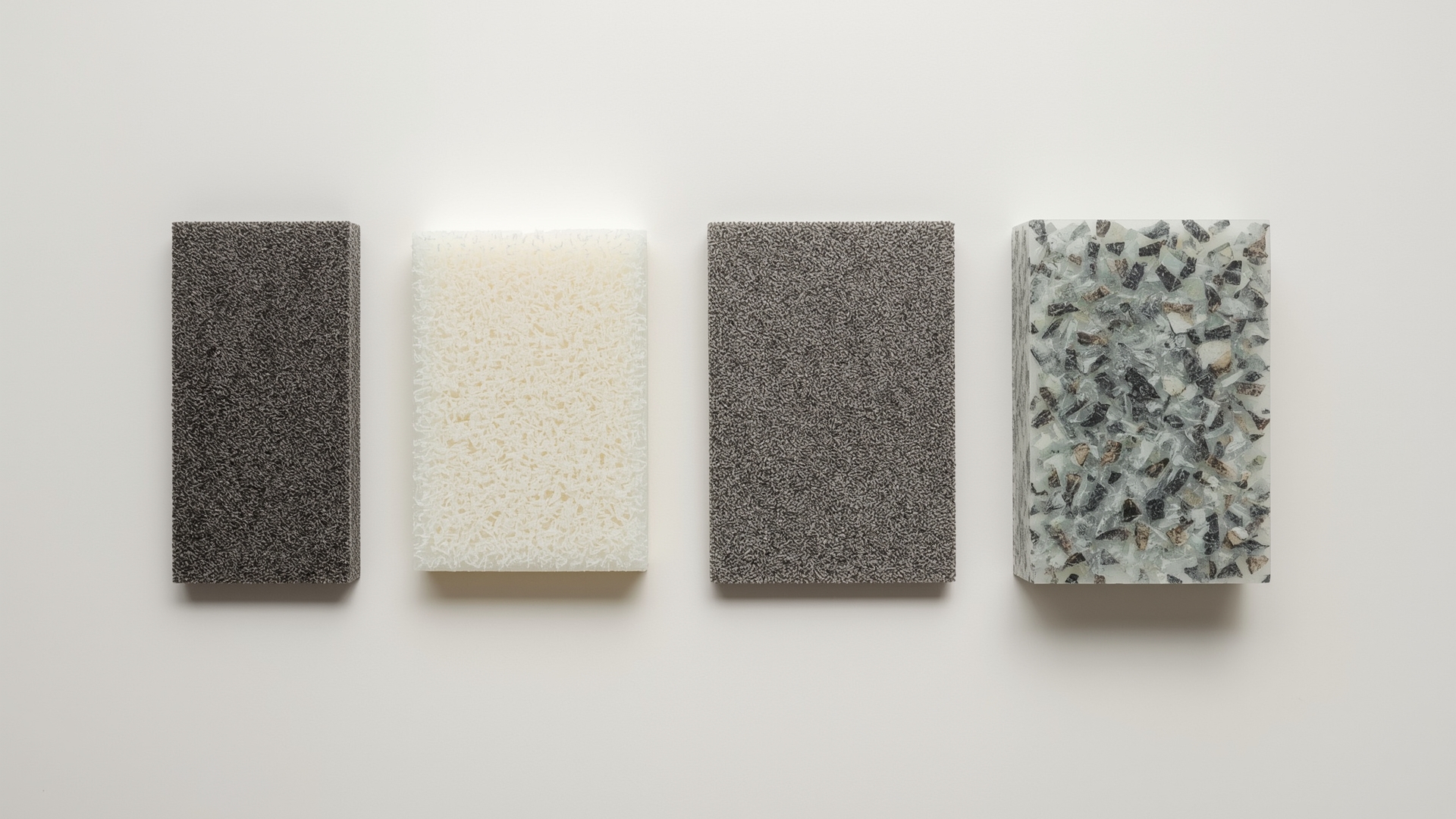
Quick Answer: Closed-cell foam pads and moisture-barrier rubber pads resist urine absorption best. Rebond foam pads, the most common type, absorb urine readily because of their open-cell structure. For pet households, moisture-barrier pads with a sealed top surface prevent liquid from entering the pad at all.
Pet Pad Comparison by Urine Resistance
| Pad Type | Urine Absorption Level | Structure Type | Cost Per Sq Ft | Typical Thickness | Pet Suitability |
|---|---|---|---|---|---|
| Rebond foam (standard) | Very high | Open-cell | $0.25 to $0.45 | 7/16″ to 3/4″ | Poor |
| Prime urethane foam | High | Open-cell | $0.40 to $0.75 | 3/8″ to 1/2″ | Poor to fair |
| Closed-cell foam | Low | Closed-cell | $0.55 to $1.00 | 1/4″ to 3/8″ | Good |
| Moisture-barrier rebond | Very low (surface) | Open-cell with sealed film | $0.60 to $1.20 | 7/16″ to 1/2″ | Very good |
| Flat rubber pad | Minimal | Dense rubber | $0.85 to $1.75 | 1/4″ to 3/8″ | Excellent |
| Fiber/felt pad | Very high | Compressed fiber | $0.30 to $0.65 | 1/4″ to 3/8″ | Very poor |
How Does a Moisture-Barrier Pad Work?
A moisture-barrier pad is a standard rebond or foam pad with a thin polyethylene or vinyl film sealed to the top surface. This film blocks liquid from entering the pad’s foam structure. Urine stays at the surface, where it can be cleaned before it soaks through.
The barrier is only effective if the film remains intact. Seam areas, edges, and any cuts or tears in the film allow liquid to bypass the barrier. During installation, seams should be taped with moisture-resistant tape. A damaged moisture-barrier pad loses its main advantage and performs no better than standard rebond.
Why Flat Rubber Pads Perform Best in Pet Households
Dense flat rubber pads have virtually no cell structure for liquid to enter. Urine stays on the surface rather than absorbing into the material. Rubber also doesn’t support mold growth as readily as foam, and it doesn’t compress permanently over time.
The trade-off is feel. Rubber pads are firmer and thinner than foam pads. Some homeowners find them less comfortable underfoot. But for households with pets and repeated accident history, the durability and moisture resistance of rubber typically outweigh the softness difference.
Why Rebond Foam Is the Worst Choice for Pet Households
Rebond pad is made from shredded recycled foam pieces bonded together. This creates an open-cell structure full of connected air pockets. When liquid hits the surface, it travels rapidly through these channels and spreads outward and downward within seconds.
Rebond is by far the most common pad type installed with new carpet because it’s inexpensive. But its sponge-like structure makes it the worst performer in pet households. Even a single incident can saturate a large section of rebond that would never fully dry without intervention.
Should You Treat the Subfloor Before Installing New Pad?
Quick Answer: Yes. Any wood subfloor showing urine staining or odor must be sealed before new pad is installed. Use a shellac-based sealer like Zinsser BIN or an oil-based primer. Concrete subfloors need cleaning plus an enzyme treatment and sealant. Skipping this step lets old odors pass through new materials.
Subfloor Assessment and Treatment Steps
- Inspect the subfloor surface after pad removal. Look for yellow, brown, or dark staining. Use a UV light in dim conditions for full visibility.
- Check for structural damage. Wood subfloor boards that have absorbed significant urine may show warping, soft spots, or delamination if the subfloor is plywood. Severely damaged boards may need replacement before new pad is installed.
- Apply enzyme treatment to wood subfloors. An enzyme-based product applied to the raw wood before sealing helps break down remaining uric acid before sealing it in place.
- Seal stained areas with shellac-based primer. Shellac-based sealers (such as Zinsser BIN) block odor transmission through wood more effectively than latex primers. Apply two coats to heavily stained areas. Allow full drying time between coats.
- For concrete subfloors, clean thoroughly, apply an enzyme product to stained zones, allow to dry completely, and then seal with a concrete-specific odor-blocking sealer. Concrete is porous and holds uric acid compounds if not properly sealed.
Subfloor Treatment Product Comparison
| Product Type | Best For | Odor Block Rating | Coverage (per gallon) | Dry Time Before Install |
|---|---|---|---|---|
| Shellac-based primer (e.g., Zinsser BIN) | Wood subfloors, heavy staining | Excellent | 300 to 400 sq ft | 45 minutes to 1 hour |
| Oil-based primer | Wood subfloors, moderate staining | Good | 350 to 450 sq ft | 4 to 8 hours |
| Water-based odor-blocking primer | Light staining, low odor | Fair | 300 to 400 sq ft | 1 to 2 hours |
| Concrete sealer (penetrating) | Concrete subfloors | Good to excellent | 200 to 300 sq ft | 2 to 4 hours |
Can You Salvage a Carpet Pad Instead of Replacing It?
Quick Answer: Pad salvage is possible only when saturation is minimal, confined to a small area, and detected early. Sub-surface extraction tools can remove urine from pad before crystals fully form. Once a pad shows structural breakdown, widespread staining, or odor despite treatment, replacement is the only effective solution.
When Sub-Surface Extraction May Work
Sub-surface extraction tools inject a cleaning solution directly into the pad and extract it back out using a weighted extraction head. This method works best when the incident is recent — within 24 to 48 hours — and before uric acid has fully crystallized in the foam structure.
For older incidents or heavy saturation, sub-surface extraction can reduce odor but rarely eliminates it fully. The foam structure absorbs and holds residue even after multiple extraction passes.
When Replacement Is the Only Option
Replacement is necessary when any of these conditions apply:
- Multiple incidents in the same zone over months or years
- Pad showing physical breakdown (crumbling, permanent compression)
- Mold or bacterial growth visible on pad surface
- Odor detectable at pad level even before extraction attempts
- More than 20 to 30% of a room’s pad area showing saturation
- Any urine penetration to the subfloor below the pad
Trying to salvage a heavily saturated pad is rarely cost-effective. Multiple treatment attempts cost more in labor and product than a straightforward pad replacement, and the results are less reliable.
What Is the Full Process for Replacing Carpet Pad After Pet Damage?
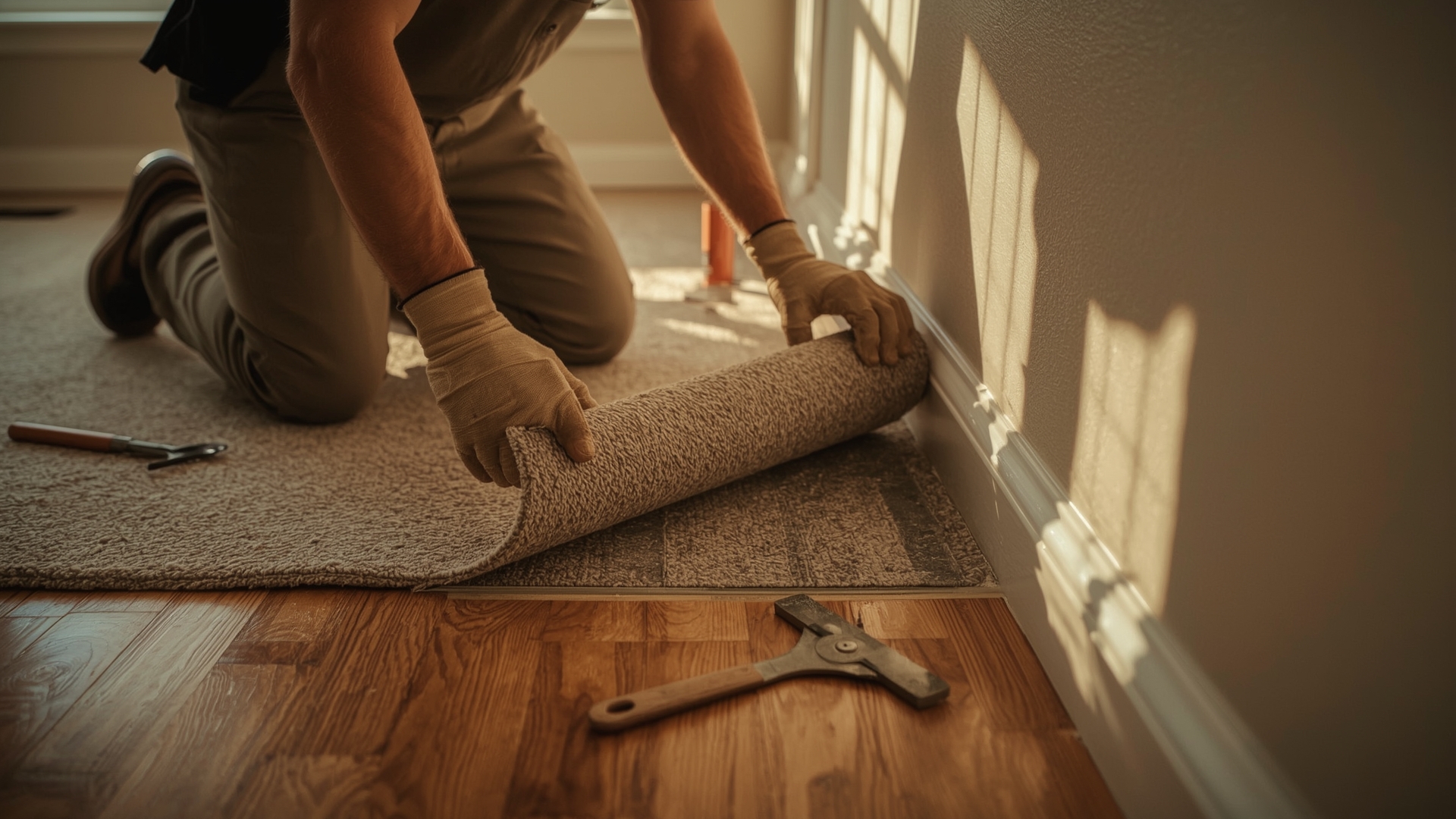
Quick Answer: The process involves pulling back the carpet, removing and disposing of the old pad, inspecting and treating the subfloor, installing new pad, and re-stretching or re-tacking the carpet. The full job takes 4 to 8 hours for a standard room, depending on subfloor condition.
Step-by-Step Pad Replacement Process
- Clear the room completely. All furniture must be removed before work begins. This includes any furniture in adjacent areas where carpet will be pulled back.
- Pull back the carpet from the tack strips. Carpet is secured along the perimeter by tack strips — narrow wood strips with protruding nails. A professional uses a knee kicker and carpet tool to release the carpet without damaging it.
- Remove and dispose of the old pad. The pad is cut into sections, rolled up, and removed. Disposal of urine-saturated pad typically requires a sealed bag or contractor bag to contain odor during transport.
- Inspect and treat the subfloor. Check for staining, structural damage, and moisture. Apply enzyme treatment, then seal as needed.
- Install new pad. The new pad is cut to fit, seams are staggered away from carpet seams, and edges are stapled or glued to the subfloor. Moisture-barrier pads require seam taping.
- Re-install the carpet. The carpet is stretched back over the pad using a power stretcher and knee kicker, then re-tacked to the strips along all walls. Seams are inspected and trimmed edges are tucked under baseboards.
Pad Replacement Timeline and Logistics
| Task | Time Required | DIY Feasibility | Notes |
|---|---|---|---|
| Furniture removal | 30 to 60 minutes | Yes | Protect floors during move |
| Carpet pull-back and pad removal | 30 to 90 minutes | Possible with tools | Risk of carpet damage without experience |
| Subfloor treatment and drying | 1 to 8 hours | Yes | Drying time drives total schedule |
| New pad installation | 30 to 60 minutes | Yes (with care) | Seams must not align with carpet seams |
| Carpet re-stretch and re-tack | 45 to 90 minutes | Not recommended | Power stretcher required for proper tension |
How Can You Protect New Carpet Pad from Future Pet Damage?
Quick Answer: Choose a moisture-barrier pad or flat rubber pad during replacement. Apply a fluoropolymer carpet protector to the new carpet surface to slow absorption. Address accidents immediately by blotting and applying an enzyme cleaner before liquid reaches the pad. Area rugs in high-risk zones add an extra protective layer.
Practical Prevention Strategies
No pad is completely immune to repeated urine exposure. Prevention is about slowing penetration so you have time to clean before damage reaches the pad level.
A fluoropolymer-based carpet protector (such as those applied after professional cleaning) creates a hydrophobic barrier on carpet fibers. This causes liquid to bead at the surface rather than wicking down immediately, giving you a longer response window.
Response time is the single biggest variable. A urine accident cleaned within 5 to 10 minutes rarely damages the pad. The same accident ignored for an hour may saturate a 12-inch radius of pad below it. Keeping enzyme cleaner and clean cloths accessible in pet-occupied rooms is a practical habit that extends pad life significantly.
Area Rugs as a Protection Layer
Placing washable area rugs in zones where accidents are most likely — sleeping areas, favorite resting spots, near doors — creates a sacrificial layer. The rug absorbs the incident before it reaches the carpet and pad below. A washable rug costs far less to replace than even a partial pad replacement.
Waterproof rug pads placed under area rugs in these zones add another protective layer and prevent the rug from sliding on the carpet surface.
Frequently Asked Questions
How long does carpet pad last before pet damage requires replacement?
A standard rebond pad lasts 10 to 15 years under normal use. With regular pet accidents in the same zones, replacement may be needed in 2 to 5 years. Pad life depends heavily on how quickly accidents are treated and how many animals use the space.
Can you replace just a section of carpet pad rather than the whole room?
Yes, partial pad replacement is possible when saturation is limited to a defined area. The carpet is pulled back in that zone, the damaged pad section is cut out and replaced, and the carpet is re-tacked. Seams between old and new pad are normal and don’t affect carpet performance.
Does carpet pad hold odor even after the carpet above is replaced?
Yes. If the old pad is left in place and new carpet is installed over it, the urine odor will transfer through the new carpet within weeks. This is one of the most common reasons new carpet smells shortly after installation in a home with pets. Always replace the pad when replacing carpet in affected rooms.
How do you know if the odor is coming from the pad or the subfloor?
Pull back a corner of carpet and lift the pad away from the subfloor. If the strongest odor comes from the pad, the pad is the primary source. If the odor intensifies when you put your nose near the bare subfloor, the wood or concrete has absorbed urine and needs treatment before new pad is installed.
Is rebond pad ever acceptable in a home with pets?
Rebond is the riskiest choice for pet households because of its high absorption rate. If budget requires using rebond, pairing it with a moisture-barrier rebond pad (which has a sealed top film) significantly improves performance. A standard rebond pad without any moisture barrier is not recommended for any room where pets spend regular time.
What thickness of carpet pad is best for pet households?
Thinner pads (3/8″ or less) dry faster and give enzyme cleaners better penetration if an accident occurs. Thicker pads (1/2″ or more) absorb more urine and take longer to dry. For pet households, a moisture-barrier pad at 7/16″ or a dense rubber pad at 1/4″ to 3/8″ offers the best balance of comfort and moisture resistance.


