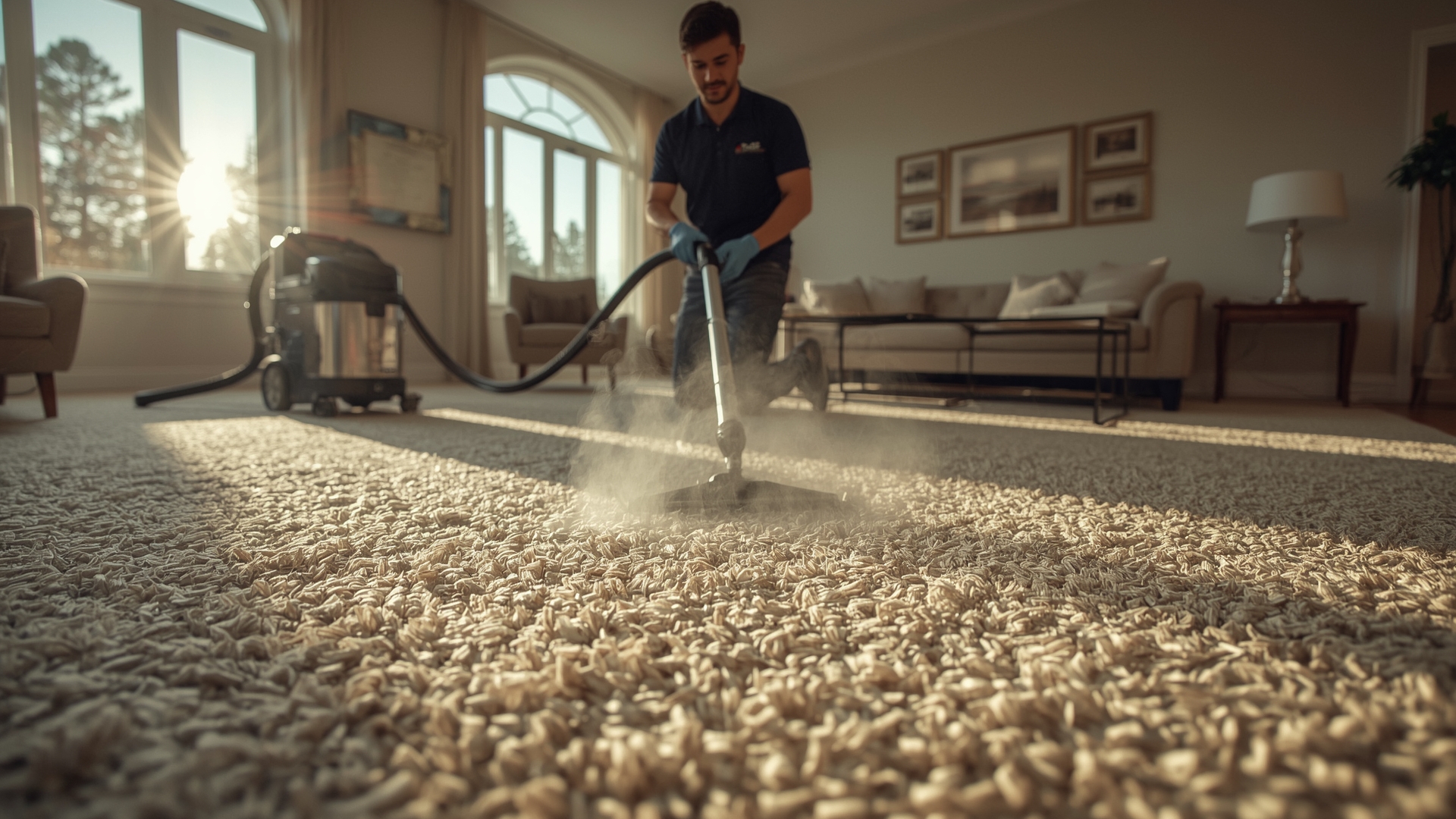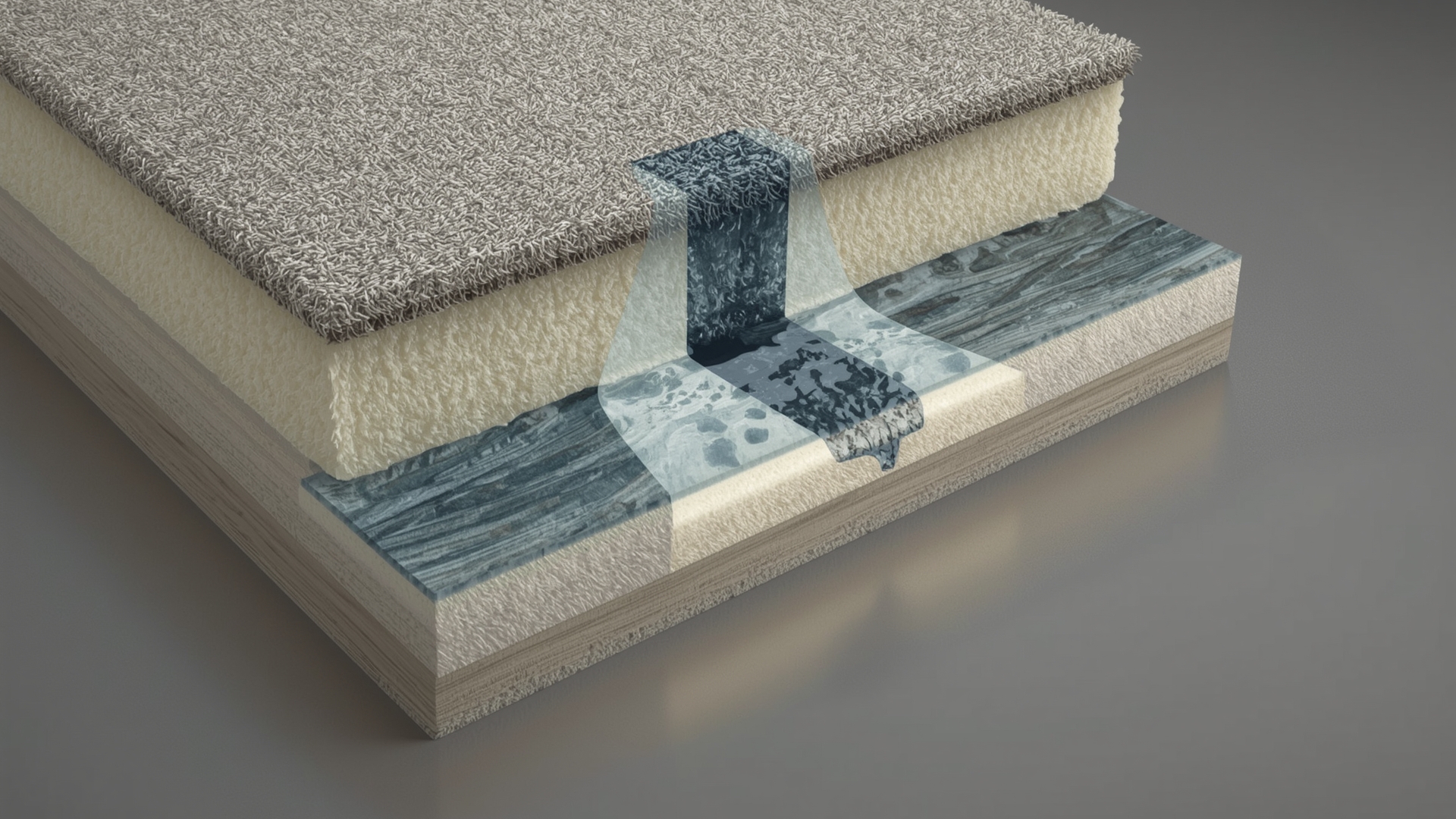
What you see on your carpet is never the whole story. A pet urine stain on the surface might look like a small spot, but underneath, the liquid has already spread through the carpet fibers, soaked into the pad, and possibly reached the subfloor. The contamination zone — the full area affected by urine — can be three to four times larger than the visible stain.
This guide walks you through how urine travels through carpet layers, how to find and measure the true contamination zone, and what a complete treatment actually looks like. Skipping any of these steps is why odors come back.
Key Takeaways
- Visible stains are misleading: The contamination zone is typically 3 to 4 times wider than the surface stain you can see.
- Urine travels downward and outward: It moves through carpet fibers, into the backing, through the pad, and sometimes into the subfloor below.
- UV light reveals hidden deposits: A 365nm UV blacklight shows urine contamination that’s invisible in normal light.
- Odor is a structural problem: Uric acid crystals bond to fibers and reactivate with humidity — surface cleaning doesn’t reach them.
- Full-zone treatment requires saturation: Treatment products must penetrate every layer the urine reached to fully neutralize contamination.
- Pad replacement is often necessary: Heavily saturated carpet pads hold contamination that no topical treatment can fully remove.
How Does Pet Urine Spread Through Carpet Layers?
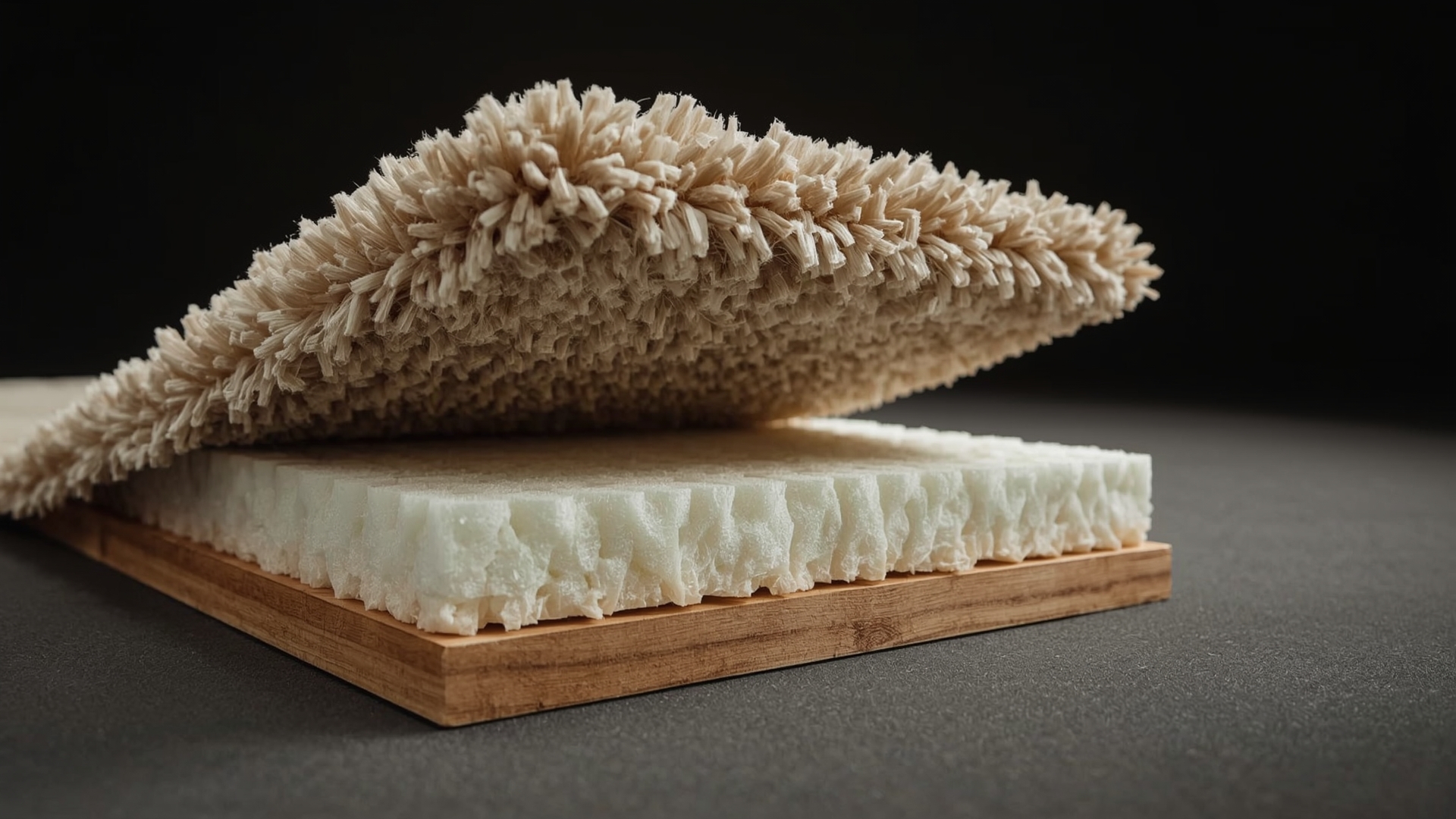
Quick Answer: Pet urine soaks through carpet fibers, the primary backing, and into the carpet pad within seconds of contact. Gravity pulls it down while capillary action spreads it outward. A single void can reach the subfloor and spread 12 to 18 inches beyond the surface stain.
Fresh urine is mostly water, which makes it highly mobile. The moment it hits carpet, gravity pulls it straight down through the pile. The carpet fibers absorb some of it, but a significant volume passes through the primary backing — the woven or tufted layer that holds the fibers — and enters the pad.
The pad acts like a sponge. It absorbs the urine quickly and spreads it laterally (outward in all directions). This is why the contamination area in the pad is almost always wider than the stain on the carpet face. On thicker, more absorbent pads, this spread is even greater.
What Happens to Urine Once It Enters the Pad?
The pad holds moisture longer than the carpet above it. As the carpet surface dries, the pad stays wet. This creates a cycle: the pad’s moisture wicks back upward into the carpet during humid conditions, reactivating odor and sometimes re-staining the surface.
If the urine volume is large enough — from repeated incidents in the same spot or from a large dog — it can saturate the pad completely and reach the subfloor. Wood subfloors absorb uric acid deeply. Concrete subfloors seal uric acid into their porous surface. Both scenarios require treatment beyond the carpet itself.
How Carpet Construction Affects Urine Spread
Not all carpets spread urine the same way. Pile height, fiber type, and backing density all affect how far urine travels.
| Carpet Type | Pile Height | Urine Spread Rate | Pad Saturation Risk | Surface Dry Time |
|---|---|---|---|---|
| Berber (loop pile) | Low (3/16 to 3/8 in) | Fast lateral spread | High | 2 to 4 hours |
| Cut pile (plush) | Medium (1/2 to 3/4 in) | Moderate spread | Moderate to high | 4 to 6 hours |
| Frieze (textured) | High (3/4 to 1 in) | Slower, absorbed in pile | Moderate | 6 to 8 hours |
| Commercial low-pile | Very low (1/8 to 1/4 in) | Very fast lateral spread | Low (thin pad) | 1 to 3 hours |
What Is the Pet Urine Contamination Zone?
Quick Answer: The contamination zone is the total area in all carpet layers where urine is present — including the surface, backing, pad, and subfloor. It’s almost always larger than the visible stain and must be fully mapped before treatment begins.
The contamination zone is not just the stain you see. It’s a three-dimensional area that includes every layer the urine has reached. Think of it as a cone shape: narrow at the top (the surface stain), wider in the middle (the pad), and potentially spreading further at the subfloor level.
Mapping this zone before treatment is critical. If you treat only the visible stain, you leave active contamination in the pad and backing. That contamination keeps producing odor, especially when humidity rises and reactivates the uric acid crystals stored there.
Why Does the Contamination Zone Keep Expanding Over Time?
With repeated incidents in the same spot, the contamination zone grows. Each new void pushes existing contamination further outward and deeper. Pets often return to the same spot because they can still smell previous deposits — even after surface cleaning.
Uric acid is the odor-causing compound in urine. It forms crystals as urine dries. These crystals are insoluble in water, which means regular cleaning doesn’t break them down. They sit in the fibers and pad until something breaks the molecular bond — which requires an enzyme or oxidizing treatment.
How Do You Use UV Light to Map a Urine Contamination Zone?
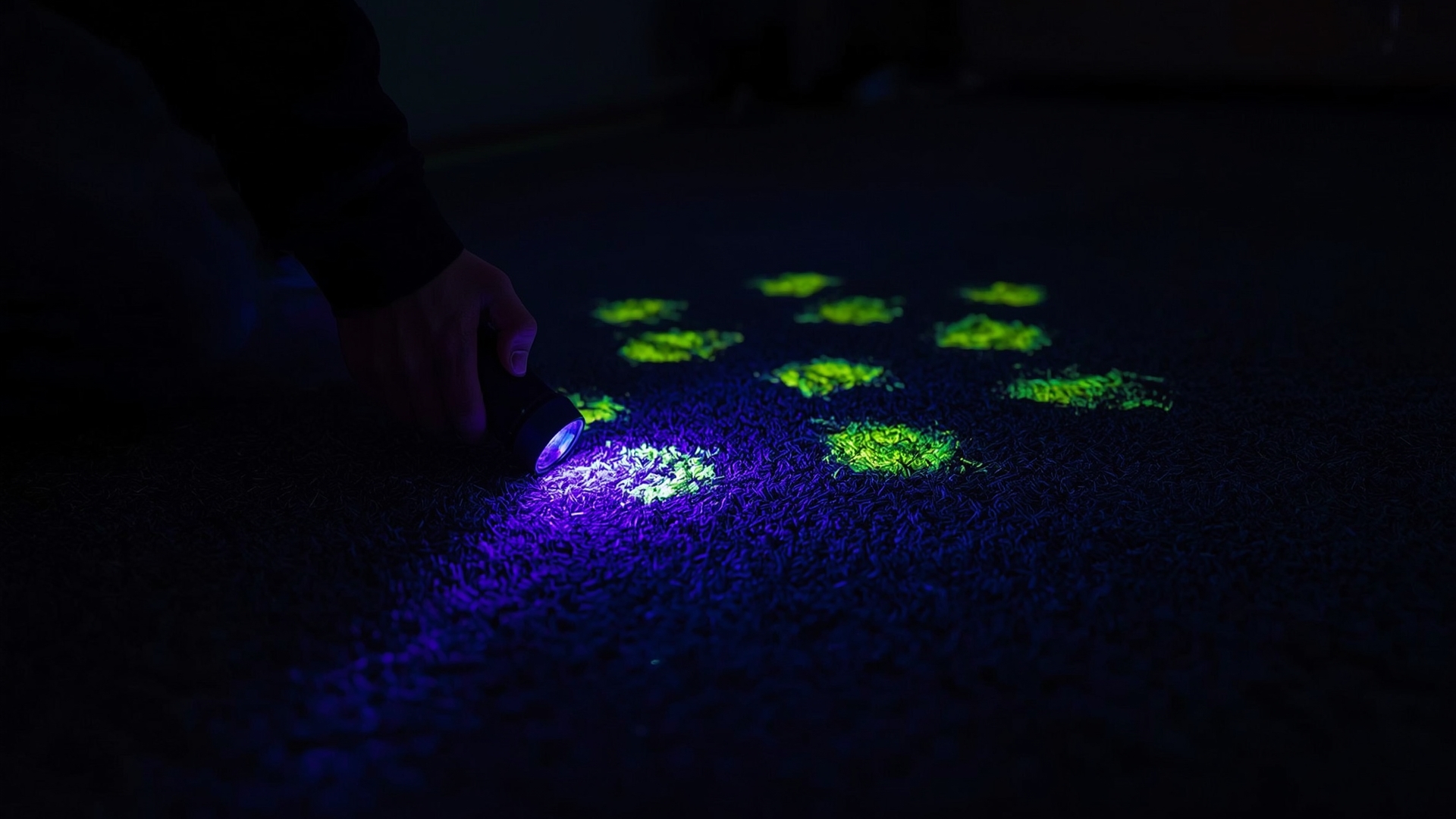
Quick Answer: Use a 365nm UV blacklight in a fully darkened room. Urine fluoresces as a yellow-green glow. Mark the outer edges of every glowing area with chalk or painter’s tape. This becomes your treatment boundary, which should extend 2 to 3 inches beyond the glow.
Choosing the Right UV Light for Urine Detection
Not every UV light works equally well. Wavelength matters. A 365nm (nanometer) UV flashlight produces the wavelength that causes urine proteins to fluoresce visibly. Cheaper lights in the 395 to 400nm range are less accurate — they cause more materials to glow, making it harder to distinguish urine from other substances.
Light intensity matters too. Higher lumen output reveals older, dried deposits that weaker lights miss. For professional-level detection, look for at minimum a 12-LED, high-output 365nm flashlight.
Step-by-Step UV Mapping Process
- Darken the room completely. Block all windows and turn off every light source. Even small amounts of ambient light reduce the fluorescence contrast.
- Let your eyes adjust. Wait 30 to 60 seconds after turning off the lights before using the UV light.
- Sweep the UV light slowly at a low angle (about 6 to 12 inches above the carpet surface).
- Mark every glowing area. Use chalk, painter’s tape, or sticky notes to outline all contamination zones.
- Extend your treatment boundary. Add 2 to 3 inches beyond the outermost edge of each marked area. Urine always travels slightly further than the visible fluorescence.
- Document with photos. Take photos of the marked zones before treatment begins. This helps verify coverage after treatment.
What Does Urine Contamination Look Like Under UV Light?
Fresh urine glows bright yellow-green. Older deposits glow more faintly — sometimes appearing as a dull yellow or white. Multiple overlapping incidents from the same spot create layered fluorescence that appears brighter at the center and fades toward the edges.
Keep in mind that other substances also fluoresce under UV light. Cleaning product residue, pet dander, and some carpet treatments can glow. The key distinguishing feature of urine is its irregular, spreading shape — often with a defined center point where the void occurred.
| Substance | UV Glow Color | Pattern Shape | Distinguishing Feature |
|---|---|---|---|
| Fresh pet urine | Bright yellow-green | Round with spreading edges | Defined center, irregular outer edge |
| Dried pet urine | Dull yellow or white | Irregular, layered rings | Fades from center outward |
| Cleaning product residue | Bright white or blue | Uniform, wiped pattern | Straight or curved edges from applicator |
| Pet dander / saliva | Light blue or white | Scattered, diffuse | No defined center or spreading pattern |
| Vomit | Orange to yellow | Pool shape with splatter | Distinct splatter marks at edges |
How Deep Does Pet Urine Actually Penetrate?
Quick Answer: A single medium-sized dog can void 200 to 400ml of urine in one incident. That volume is enough to fully saturate a 6-inch diameter carpet area and penetrate the pad down to the subfloor. Repeated incidents at the same spot multiply the depth and spread significantly.
Understanding Urine Volume and Contamination Depth
Volume determines depth. A small cat incident (50 to 100ml) may only reach the top half of the pad. A large dog incident (300 to 500ml) can push through the entire pad and soak into the subfloor material below.
Contamination depth also depends on how quickly the incident was discovered. Fresh urine treated within minutes stays largely in the surface fibers. Urine that dries over hours or days has more time to wick deeper and crystallize in the lower layers.
| Animal | Avg. Void Volume | Surface Stain Diameter | Estimated Pad Spread | Subfloor Risk |
|---|---|---|---|---|
| Small cat | 50 to 100ml | 3 to 5 inches | 8 to 12 inches | Low (single incident) |
| Large cat | 100 to 150ml | 4 to 7 inches | 10 to 15 inches | Moderate (repeated) |
| Small dog (under 25 lbs) | 100 to 200ml | 5 to 8 inches | 12 to 18 inches | Moderate |
| Medium dog (25 to 60 lbs) | 200 to 400ml | 8 to 14 inches | 16 to 24 inches | High |
| Large dog (over 60 lbs) | 300 to 500ml | 12 to 20 inches | 20 to 30 inches | Very high |
What Does Full-Zone Urine Treatment Actually Involve?
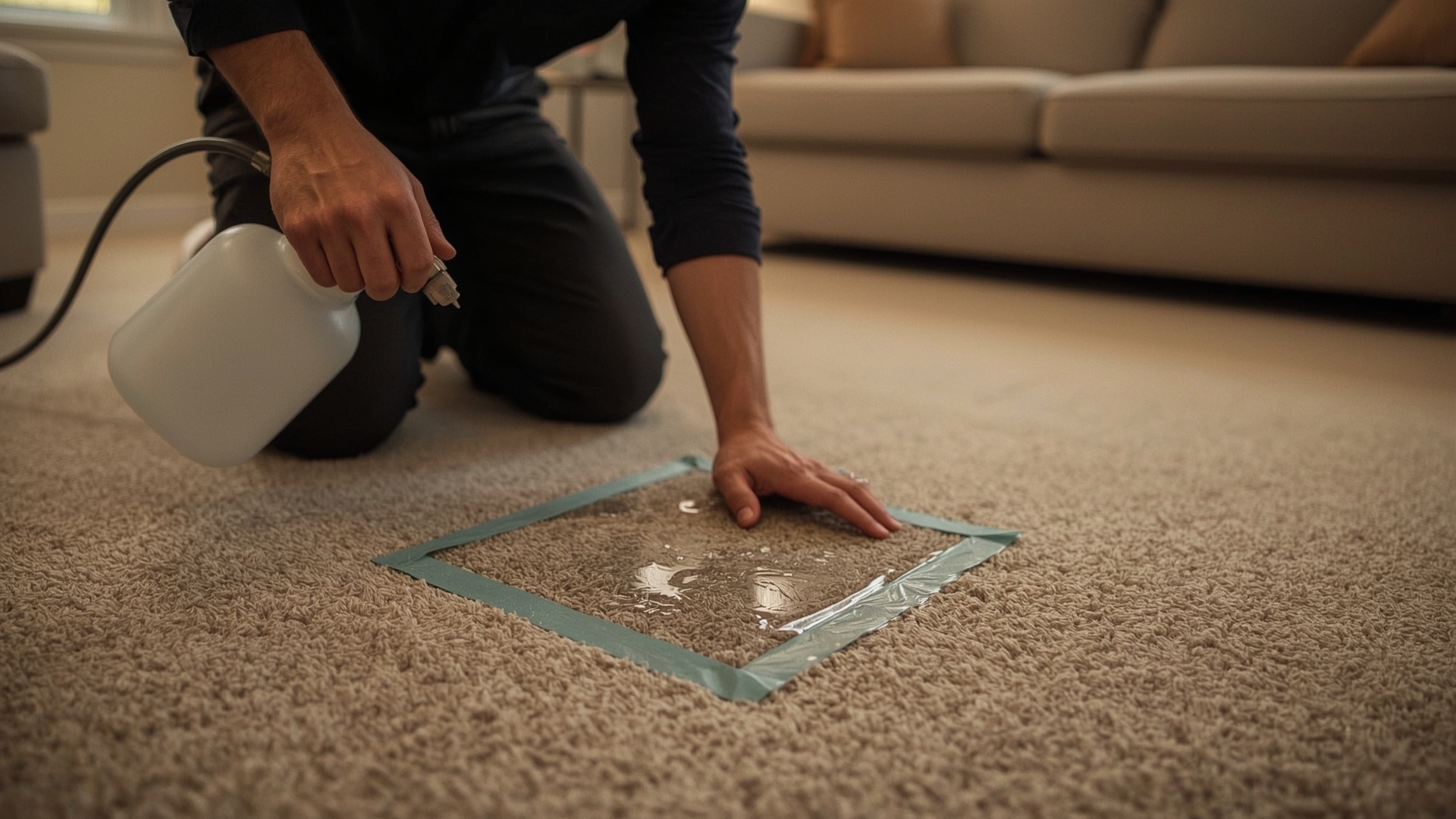
Quick Answer: Full-zone treatment requires saturating every contaminated layer — carpet face, backing, pad, and subfloor if affected — with a treatment product in quantities that match the original urine volume. Surface-only cleaning doesn’t neutralize contamination in the pad or subfloor.
The Saturation Principle in Urine Treatment
The core rule of effective urine treatment is this: the treatment solution must reach every layer the urine reached. That means applying enough volume to penetrate through the carpet, through the backing, and into the pad. You’re essentially following the same path the urine took.
Enzyme treatments — cleaners that use biological enzymes to break down uric acid crystals — need direct contact with the contamination to work. If they stop at the carpet surface, the uric acid in the pad continues producing odor. Enzymes are active for a limited time, typically 24 to 72 hours, so dwell time matters.
Treatment Steps for a Confirmed Contamination Zone
- Map the zone first. Use UV light to identify and mark all contamination boundaries before applying anything.
- Extract standing moisture. If the area is still wet, use a wet-vac or extraction tool to remove as much liquid as possible before treating.
- Apply treatment at saturation volume. Use enough product to match the estimated urine volume — not just enough to dampen the surface.
- Work outward from the center. Apply product starting at the outer edge of the marked zone and work inward. This prevents pushing contamination further out.
- Allow full dwell time. Keep the treated area moist and covered (plastic sheeting works) for the product’s recommended contact time, typically 24 to 48 hours for enzyme treatments.
- Extract thoroughly. After dwell time, extract all moisture with a carpet extractor or sub-surface extraction tool that pulls liquid from the pad layer.
- Assess and repeat if needed. Re-check with UV light after the carpet is fully dry. Remaining fluorescence indicates residual contamination requiring a second treatment pass.
When Does the Carpet Pad Need to Be Replaced?
Pad replacement becomes necessary when contamination has soaked through the entire pad thickness and the pad has lost structural integrity from repeated saturation. A saturated pad that has been wet and re-dried multiple times develops permanent odor and becomes a bacterial reservoir that treatment products cannot fully penetrate.
Signs the pad needs replacement: strong odor even after enzyme treatment, pad material that crumbles or separates when touched, visible discoloration on the pad’s underside, or UV fluorescence that persists after two full treatment cycles.
Treating the Subfloor When Urine Has Penetrated Through
If urine has reached the subfloor, the carpet and pad must be pulled back to treat it directly. For wood subfloors, a sealer — typically an oil-based primer or shellac-based product — is applied after cleaning to encapsulate any remaining uric acid that can’t be fully removed from the wood grain.
Concrete subfloors are treated with a topical enzyme or oxidizing solution, then sealed with a concrete sealer after the treatment has been extracted. Skipping the seal step allows residual uric acid to continue off-gassing through the new pad and carpet over time.
Why Does Pet Urine Odor Come Back After Cleaning?
Quick Answer: Pet urine odor returns because uric acid crystals in the pad or backing were never neutralized. Humidity causes these crystals to dissolve slightly and release odor compounds again. Surface cleaning only masks the smell temporarily — it doesn’t break down the uric acid.
The Role of Humidity in Odor Reactivation
Uric acid is hygroscopic — it absorbs moisture from the air. When indoor humidity rises above 50%, dried uric acid crystals absorb that moisture and partially dissolve. This releases the volatile compounds responsible for the ammonia-like odor associated with old urine.
This is why urine odor is often worse in summer or in humid climates. The temperature doesn’t cause the smell — the moisture does. Controlling indoor humidity (ideally below 50% relative humidity) helps reduce reactivation events, but it doesn’t solve the underlying contamination.
Why Standard Carpet Cleaning Doesn’t Solve Urine Odor
Hot water extraction — the most common professional carpet cleaning method — is effective for removing surface soils. But it uses heat and water, which can actually make urine odor temporarily worse by dissolving the uric acid crystals and spreading them further during cleaning.
Standard cleaning also doesn’t address the pad or subfloor. The water and cleaning agents reach the carpet fibers, but not the full contamination depth. After the carpet dries, the uric acid crystals re-form exactly where they were — in the pad, still active.
| Cleaning Method | Reaches Pad? | Breaks Down Uric Acid? | Effective for Odor? | Best Use |
|---|---|---|---|---|
| Hot water extraction (standard) | No | No | Temporary only | Surface soil and general cleaning |
| Enzyme treatment (topical) | Partial | Yes (at contact area) | Good for light contamination | Fresh or single-incident spots |
| Enzyme treatment (full saturation) | Yes | Yes (full zone) | Excellent | Confirmed contamination zones |
| Oxidizing treatment | Yes (with saturation) | Yes (chemical oxidation) | Excellent for heavy deposits | Severe or repeated contamination |
| Pad replacement + subfloor seal | N/A (pad removed) | Yes (source removed) | Complete solution | Heavily saturated areas |
What Are the Health Risks of Untreated Urine Contamination in Carpet?
Quick Answer: Untreated pet urine creates a moist environment that supports bacterial growth, including ammonia-producing bacteria and mold. Ammonia exposure irritates the respiratory tract. People with asthma or allergies are particularly sensitive to the airborne compounds released by contaminated carpet.
Bacterial Activity in Contaminated Carpet
Fresh urine is sterile, but it doesn’t stay that way. Within hours of contact with carpet, bacteria from the pet’s urinary tract and from the environment begin breaking down the urea in urine. This process produces ammonia as a byproduct — which is the sharp, chemical smell associated with old urine deposits.
The warm, moist environment inside a contaminated carpet pad is ideal for bacterial growth. In heavily contaminated areas, bacterial colony counts can reach levels that affect indoor air quality. Young children who crawl on carpets are most directly exposed.
Mold Risk in Urine-Saturated Carpet
Carpet pads that stay damp from urine contamination for more than 24 to 48 hours can develop mold growth. Mold spores are naturally present in most indoor environments — all they need is a moisture source and an organic substrate, both of which a urine-saturated pad provides.
Mold in carpet padding is difficult to detect without lifting the carpet. Musty odors combined with pet urine smell often indicate co-occurring mold contamination, which requires a different remediation approach than urine treatment alone.
How Can You Prevent Contamination Zones From Growing Larger?
Quick Answer: Act within the first 5 minutes of discovering a fresh accident. Blot (never rub) the surface to remove as much liquid as possible before it penetrates the pad. Applying cold water to dilute and blot further reduces the urine volume that reaches deeper layers.
Immediate Response to Fresh Pet Urine
Speed is the most important factor in limiting contamination zone size. The longer urine sits, the more it spreads through capillary action and the deeper it penetrates. Within the first 5 minutes, a significant portion of the urine is still in the carpet fibers and hasn’t fully saturated the pad.
Use white absorbent cloths or paper towels to blot from the outer edge of the spot inward. Press firmly. Don’t scrub or rub — that pushes liquid deeper into the fibers and spreads it outward. After blotting, apply cold water to dilute remaining urine and blot again. Repeat until the cloth comes up clean.
Carpet Protector Treatments and Urine Resistance
Fluoropolymer-based carpet protectors — applied after professional cleaning — create a hydrophobic barrier on carpet fibers. This gives you more time to respond to accidents before urine penetrates. Protectors don’t make carpet urine-proof, but they slow absorption from immediate saturation to a window of 5 to 15 minutes.
Protectors wear off with foot traffic and cleaning over time. Reapplication is typically needed after each professional cleaning, or every 12 to 18 months in high-traffic areas with pets.
When Should You Call a Professional for Urine Contamination?
Quick Answer: Call a professional when UV mapping reveals contamination zones larger than 12 inches in diameter, when odor persists after two DIY treatment attempts, or when contamination has likely reached the subfloor. These scenarios require sub-surface extraction tools and possible pad replacement.
What Professional Tools Can Do That DIY Products Cannot
Professional-grade sub-surface extraction tools — sometimes called water claws or sub-surface extractors — create a suction seal directly against the carpet surface. They pull treatment product and contamination out from the pad layer, not just the carpet face. This is physically impossible to replicate with a standard shop-vac or consumer carpet cleaner.
Professionals also use commercial-concentration enzyme and oxidizing products with higher active ingredient percentages than retail versions. Combined with the ability to apply and extract at the pad level, this produces substantially better results on severe contamination than DIY approaches.
Signs That DIY Treatment Isn’t Working
- Odor returns within 3 to 7 days of treatment
- UV light still shows fluorescence after the carpet fully dries
- The treated area develops a stiff or crusty texture after drying
- New staining appears at the treatment site after drying (wicking)
- Musty odor develops alongside urine odor, suggesting mold
Frequently Asked Questions
Can you smell pet urine contamination before you can see it?
Yes. Odor often indicates contamination that has dried and crystallized in the pad, making it invisible on the surface. If you smell urine but see no stain, use a UV blacklight in a dark room to locate the source.
Does steam cleaning remove pet urine odor from carpet?
Steam cleaning alone does not remove urine odor. The heat can temporarily intensify the smell by activating uric acid compounds. Effective odor removal requires a treatment — enzyme or oxidizer — that chemically breaks down uric acid crystals.
How many times can you treat the same contamination zone before replacing the pad?
Most contamination zones can be treated two to three times effectively. After that, the pad material degrades and holds residual contamination even after treatment. Persistent odor after two full saturation treatments is a reliable sign that pad replacement is needed.
Is pet urine contamination worse in carpet with attached cushion backing?
Yes. Carpet with attached cushion backing — where the pad is bonded directly to the carpet — is harder to treat because the pad layer can’t be replaced separately. Contamination becomes trapped between the bonded layers and is difficult to extract fully.
Does the type of pet affect how bad the contamination is?
Cat urine generally produces more concentrated and persistent odor than dog urine because of higher levels of felinine, a protein compound unique to cats. Volume matters too — large dogs produce more urine per incident, creating larger contamination zones even if the odor concentration is lower.
Can pet urine contamination in carpet affect hardwood floors underneath?
Yes. When urine saturates through the carpet and pad, it reaches the subfloor. On wood subfloors, uric acid penetrates the grain and can cause permanent discoloration and odor that persists even after carpet replacement. Sealing the subfloor before installing new carpet is essential in these cases.