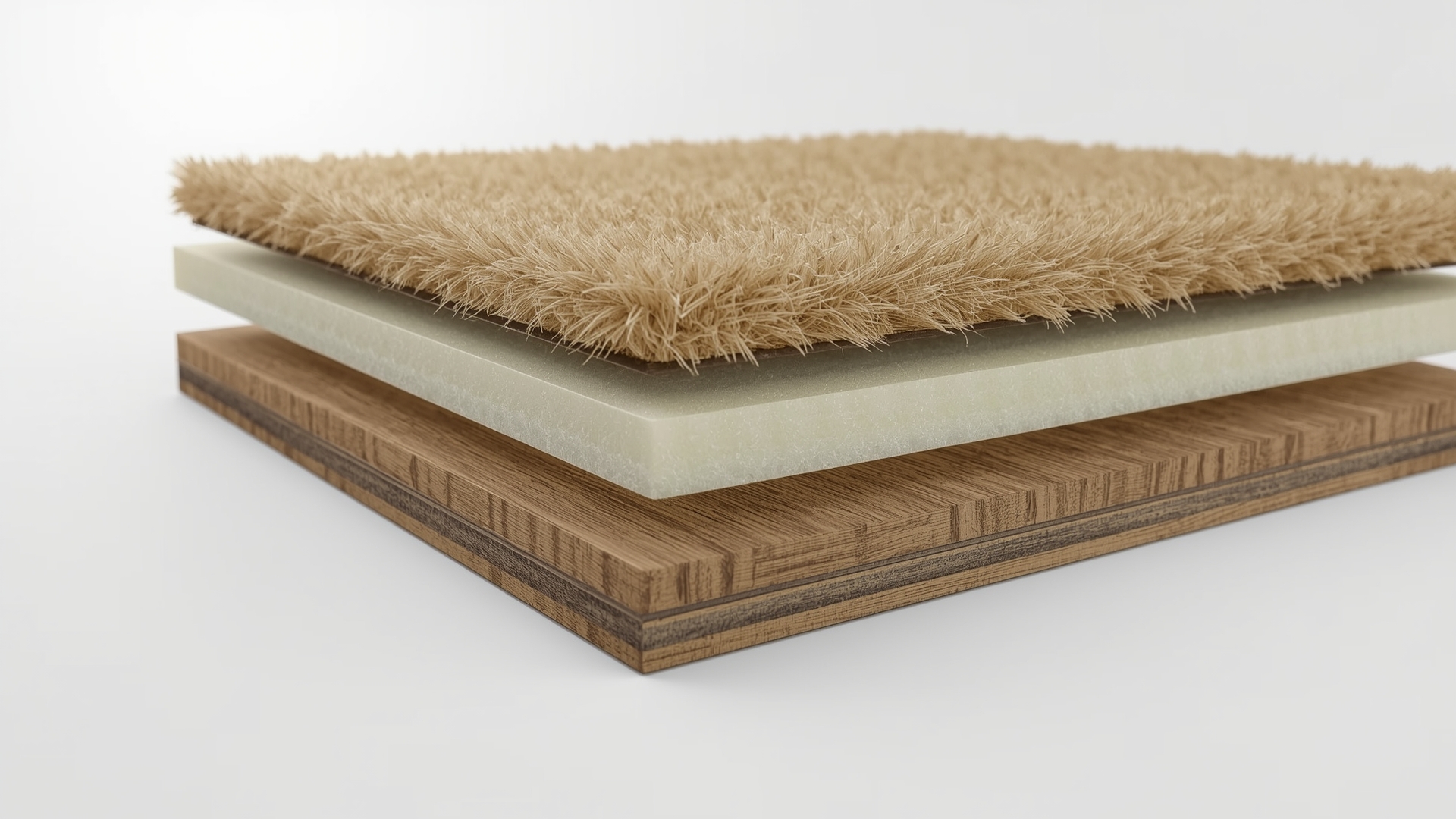
The carpet gets all the attention, but the pad underneath quietly controls how your floor feels, sounds, and lasts. Choose the wrong pad and even a high-quality carpet wears out early, feels flat, or holds moisture long after a spill. Choose the right one and your carpet performs like it costs twice as much.
This guide covers every major carpet pad type, what the thickness and density numbers actually mean, and which combination fits different carpet constructions and rooms.
Key Takeaways
- Density matters more than thickness. A dense, thinner pad outlasts a soft, thick one in high-traffic areas.
- Standard thickness is 7/16 inch for most residential carpet. Berber and loop-pile carpets need thinner pads (3/8 inch or less).
- Rebond foam is the most common pad type and works well in most rooms. Memory foam, waffle rubber, and flat rubber serve specific needs.
- Moisture barrier pads are worth the upgrade in basements, kitchens, or pet-heavy households.
- Pad density is measured in pounds per cubic foot. Residential traffic needs at least 6 lb density; heavy-traffic areas need 8 lb or more.
- A pad that’s too thick can void your carpet’s warranty and cause seams to buckle or shift.
What Is Carpet Pad and Why Does It Matter?
Quick Answer: Carpet pad is the cushioning layer installed between your carpet and the subfloor. It adds comfort underfoot, absorbs impact noise, improves insulation, and extends carpet life by reducing fiber stress from foot traffic and furniture weight.
Without a pad, every step compresses your carpet fibers directly against the hard subfloor. That friction breaks down the fiber roots faster than almost anything else. A good pad acts as a shock absorber, spreading the pressure so fibers spring back instead of getting crushed flat.
Pad also affects how your carpet dries after cleaning or a spill. Thin, dense pads dry faster. Thick, open-cell foam holds water longer, which can lead to mold growth underneath if airflow is limited.
Most carpet manufacturers require a specific pad thickness and density range to keep the warranty valid. Ignoring that spec is one of the most common and most avoidable installation mistakes.
What Are the Main Types of Carpet Pad?
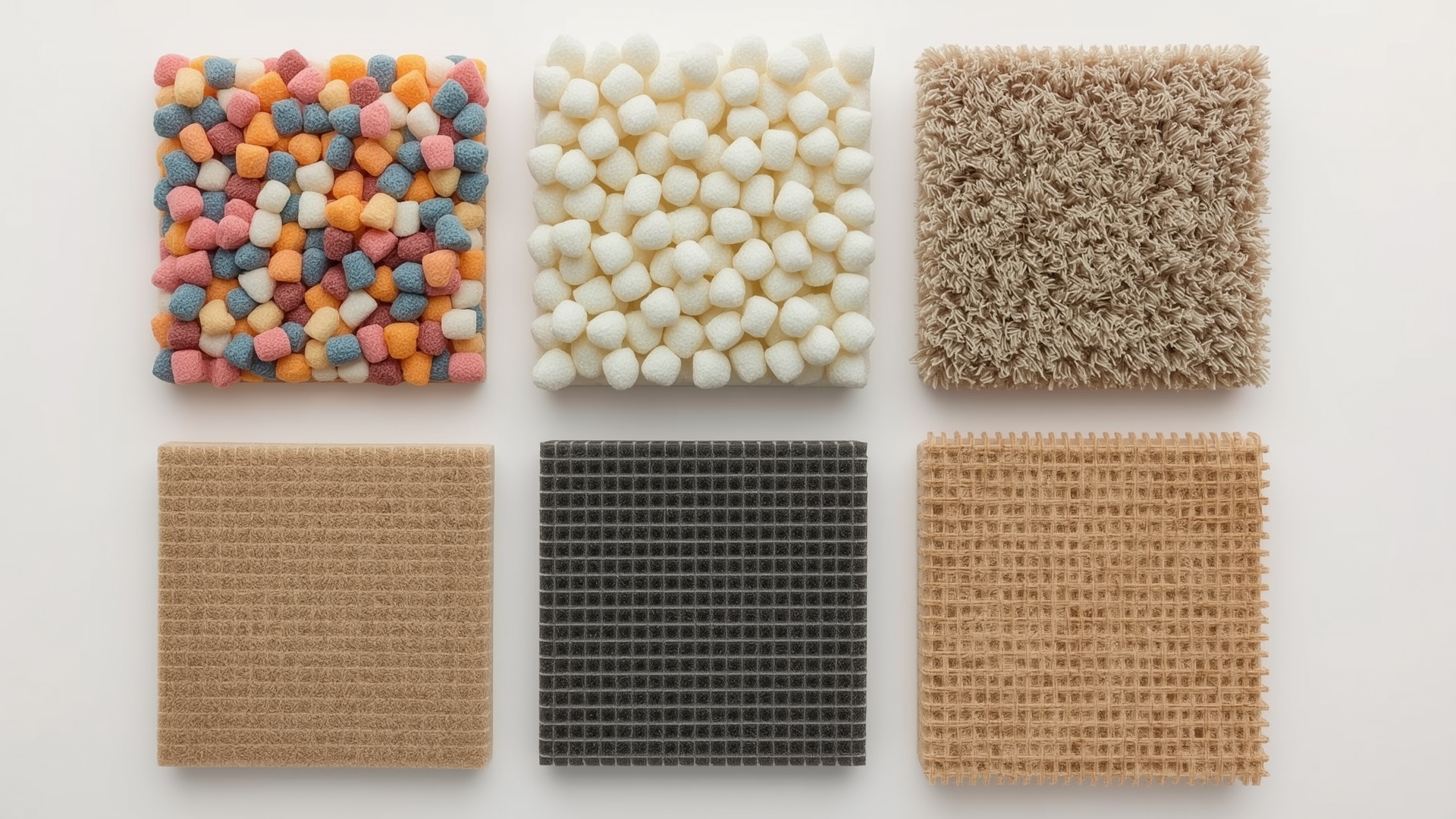
Quick Answer: The six main carpet pad types are rebond foam, prime polyurethane foam, memory foam, flat rubber, waffle rubber, and fiber pad. Each material differs in density, moisture resistance, durability, and cost per square yard.
Rebond Foam
Rebond foam is made from recycled polyurethane chunks bonded together under heat and pressure. It is the most widely used residential pad in the U.S. The multicolored appearance is normal and comes from mixing different foam colors during recycling.
It handles moderate traffic well and costs less than most alternatives. Rebond foam comes in a wide range of densities and thicknesses, making it easy to match to different carpet types.
Prime Polyurethane Foam
Prime foam is a single-pour polyurethane product, not recycled. It is more uniform in texture than rebond and provides consistent softness underfoot. However, it breaks down faster in high-traffic areas because the cell structure is more open and compressible.
Prime foam works best in low-traffic bedrooms where comfort is the priority.
Memory Foam
Memory foam carpet pad uses viscoelastic foam, the same material found in mattresses. It responds slowly to pressure and feels noticeably softer than rebond. The trade-off is cost: memory foam pad runs significantly higher per square yard and is not ideal for heavy furniture or very high traffic.
Flat Rubber (Slab Rubber)
Flat rubber is the most durable pad type available. It resists compression, holds its shape under heavy foot traffic and furniture, and does not absorb moisture. It is the standard choice for commercial installations and also works well in residential hallways, stairs, and living rooms that see constant use.
Flat rubber pad costs more upfront but lasts as long as the carpet itself in most cases.
Waffle Rubber
Waffle rubber has a textured, grid-like surface and feels softer than flat rubber. It was popular in older installations but has largely been replaced by rebond foam because it can harden and crumble over time, especially in dry climates or rooms with temperature swings.
Fiber Pad
Fiber pads are made from natural or synthetic fibers, including jute, wool, or recycled textile fibers. They are firm, thin, and resistant to moisture absorption. Fiber pad works well under area rugs and Berber carpets. It does not compress like foam, which makes it a safe choice for loop-pile constructions.
What Do Carpet Pad Thickness Numbers Mean?
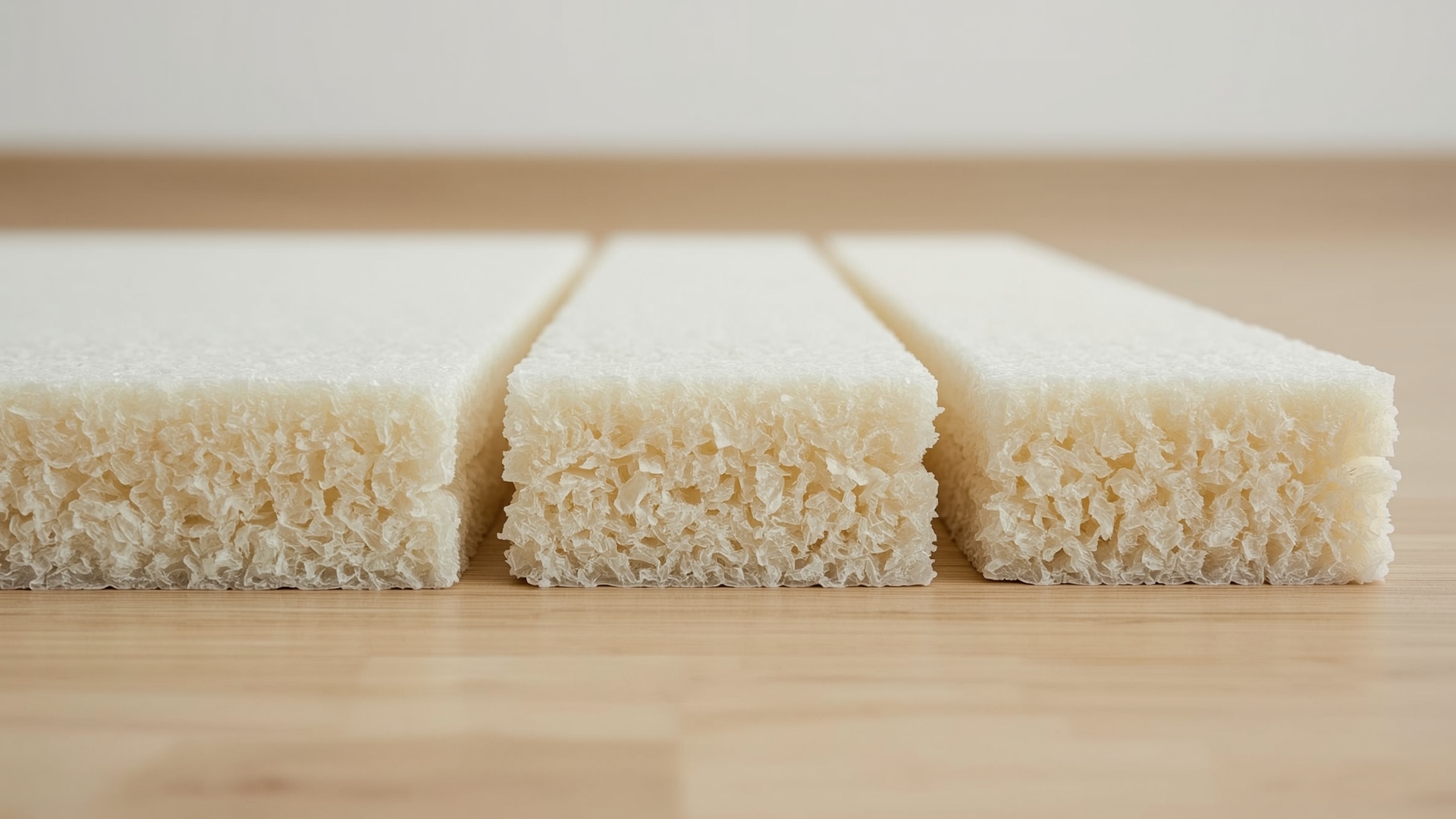
Quick Answer: Carpet pad thickness is measured in fractions of an inch. Standard residential thickness is 7/16 inch. Berber and loop-pile carpets require pads no thicker than 3/8 inch. Going thicker than recommended causes seam instability and can void your carpet warranty.
Thickness affects how plush the floor feels underfoot. But softness and durability do not always go together. A thick pad that compresses easily will bottom out quickly, leaving you with a flat, unsupported carpet within a few years.
The carpet warranty usually specifies a maximum pad thickness. That number exists because carpet installers and manufacturers know that too much give underneath causes the carpet backing to flex repeatedly, which breaks down adhesive seams and damages tufting rows.
Thickness Ranges by Application
| Application | Recommended Thickness | Notes |
|---|---|---|
| Standard residential (cut-pile) | 7/16 inch (0.44 in) | Most versatile choice for bedrooms, living rooms |
| Berber / loop-pile carpet | 3/8 inch (0.375 in) or less | Thicker pads cause seam stress and backing damage |
| Stairs | 3/8 inch to 7/16 inch | Thin enough to stay tight on the nose of each step |
| Commercial / high-traffic | 1/4 inch to 3/8 inch | Prioritize density over thickness here |
| Low-traffic bedroom | Up to 1/2 inch | Comfort-focused; check carpet warranty first |
| Basement installation | 3/8 inch with moisture barrier | Vapor layer required to prevent subfloor moisture damage |
What Does Carpet Pad Density Mean and How Do You Read It?
Quick Answer: Pad density is measured in pounds per cubic foot (lb/ft³). It tells you how tightly packed the foam or rubber material is. A 6 lb density pad suits standard residential traffic. High-traffic rooms and stairs need 8 lb or higher for long-term durability.
Density is the single most important number on a carpet pad spec sheet. Two pads can share the same thickness but feel completely different underfoot because one is much denser than the other.
Think of density like a sponge. A loose, airy sponge compresses all the way down easily. A firm, dense sponge pushes back. Carpet pad works the same way. Higher density means the pad holds its shape longer under daily foot traffic.
Density Ratings by Pad Type
| Pad Type | Typical Density Range | Minimum for High-Traffic | Lifespan (Residential) | Cost Range (per sq yd) |
|---|---|---|---|---|
| Rebond Foam | 5 to 10 lb/ft³ | 8 lb/ft³ | 8 to 12 years | $0.50 to $1.50 |
| Prime Polyurethane Foam | 2.5 to 3.5 lb/ft³ | Not recommended | 4 to 7 years | $0.40 to $0.90 |
| Memory Foam | 3 to 5 lb/ft³ | Not recommended | 5 to 8 years | $1.50 to $3.00 |
| Flat Rubber (Slab) | 18 to 22 oz/sq yd* | All traffic levels | 20+ years | $2.00 to $5.00 |
| Waffle Rubber | 56 to 64 oz/sq yd* | Not recommended | 5 to 10 years | $0.75 to $2.00 |
| Fiber Pad | 28 to 40 oz/sq yd* | 32 oz/sq yd | 10 to 15 years | $1.00 to $2.50 |
*Rubber and fiber pads use ounces per square yard instead of pounds per cubic foot as their density measure.
Which Carpet Pad Works Best for Different Carpet Types?
Quick Answer: Cut-pile carpets pair well with 7/16-inch rebond foam at 6 to 8 lb density. Berber and loop-pile carpets need a firm, thin fiber or flat rubber pad no thicker than 3/8 inch. Plush carpets benefit from 8 lb rebond for shape retention.
Cut-Pile Carpet (Saxony, Frieze, Textured)
Cut-pile is the most common residential carpet style. The individual fibers are cut at the tips rather than looped. This style is forgiving with pad selection. A 7/16-inch rebond foam at 6 to 8 lb density handles most rooms well.
For plush Saxony styles, slightly higher density (8 lb) helps prevent the carpet from looking matted in traffic lanes.
Berber and Loop-Pile Carpet
Berber carpet is woven in a continuous loop pattern. This construction is naturally firm and does not need a thick pad for comfort. In fact, too much thickness underneath causes the loops to flex unevenly, which leads to snags, pulled loops, and seam separation over time.
The recommended pad for Berber is a firm fiber pad or thin flat rubber, no thicker than 3/8 inch and no softer than 32 oz for fiber or 8 lb for foam.
Frieze and Textured Plush
Frieze carpet has tightly twisted, shorter fibers that resist crushing well on their own. A standard 7/16-inch rebond foam at 6 lb works fine here. Going denser (8 lb) adds longevity in high-use areas without sacrificing comfort.
Commercial Carpet Tile and Broadloom
Commercial carpet is usually glued directly to the subfloor or installed over a very thin pad. Where pad is used, flat rubber at 1/4 to 3/8 inch is standard. The goal is dimensional stability, not softness.
Does Pad Thickness Affect Carpet Drying Time After Cleaning?
Quick Answer: Yes. Thicker, open-cell foam pads absorb and hold more water during cleaning. They can extend carpet drying time by 4 to 12 hours compared to dense or rubber pads. Moisture trapped in the pad promotes mold and bacterial growth beneath the carpet.
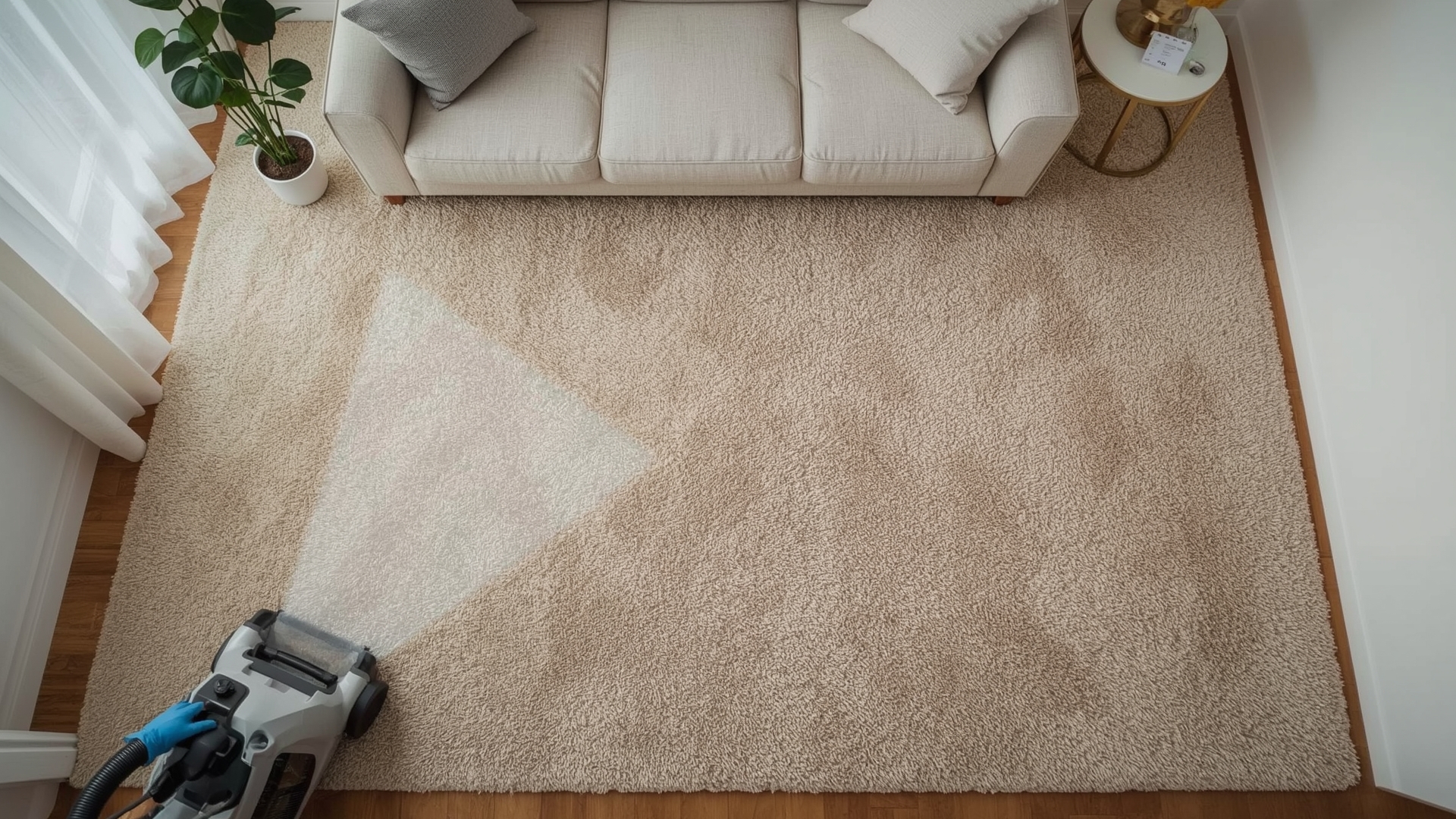
During professional hot water extraction cleaning, water and cleaning solution penetrate through the carpet fibers and into the pad. Dense foam and rubber pads release this moisture more readily because they have fewer open cells to trap water.
Thick prime foam and low-density rebond pads act more like a sponge. They hold moisture even after the carpet surface feels dry to the touch. That trapped water can sit in the pad for 24 to 48 hours, creating conditions that support mold growth and odor development.
If your home has pets or you get your carpet cleaned frequently, a moisture-barrier pad or flat rubber pad is a practical investment. It reduces drying time and makes post-cleaning odors far less likely.
What Is a Moisture Barrier Pad and When Do You Need One?
Quick Answer: A moisture barrier pad has a thin plastic or film layer bonded to the top surface. It slows liquid penetration into the foam, buying time to blot up spills before they reach the subfloor. It is recommended for basements, pet households, and areas prone to spills.
A moisture barrier is not waterproof. Think of it as a delay. Liquids that sit on the surface for more than a few minutes will eventually seep through the seams or edges of the pad. But for everyday accidents, it gives you time to respond.
In basements, a moisture barrier pad also protects against vapor rising from the concrete subfloor. Without it, humidity from the slab can condense under the carpet, causing mold and musty odors that are difficult to eliminate.
Pet households benefit from moisture barrier pads specifically because urine pools quickly and soaks deep. Even with a barrier, severe contamination can still reach the subfloor, which is why prompt cleanup always matters more than the pad type alone.
How Does Carpet Pad Affect Noise and Insulation?
Quick Answer: Carpet pad reduces airborne noise by 25 to 35 decibels and impact noise (footsteps) by up to 50 decibels in multi-story homes. Thicker, denser pads provide better sound dampening. Rebond foam and flat rubber both perform well for noise reduction.
Pad acts as an acoustic buffer between floors. In apartments or two-story homes, this matters significantly. A quality pad reduces the sound of footsteps, dropped items, and furniture movement traveling through the subfloor to the room below.
For thermal insulation, carpet pad adds an R-value of roughly 0.5 to 1.0 depending on thickness and material. Fiber pads rate slightly higher than foam for thermal resistance because natural fibers trap more air.
Acoustic Performance by Pad Type
| Pad Type | Impact Noise Reduction (approx.) | Thermal R-Value (approx.) | Best Acoustic Use Case |
|---|---|---|---|
| Rebond Foam (8 lb) | 40 to 50 dB reduction | R-0.6 to R-0.8 | Multi-story residential bedrooms |
| Memory Foam | 45 to 55 dB reduction | R-0.7 to R-0.9 | Home theaters, bedrooms |
| Flat Rubber | 35 to 45 dB reduction | R-0.3 to R-0.5 | Hallways, stairs, commercial spaces |
| Fiber Pad | 30 to 40 dB reduction | R-0.9 to R-1.2 | Basements, area rug underlays |
| Waffle Rubber | 25 to 35 dB reduction | R-0.4 to R-0.6 | Low-traffic rooms only |
How Do You Choose the Right Carpet Pad for Each Room?

Quick Answer: Match pad type to traffic level, carpet construction, and moisture risk. Bedrooms get 7/16-inch rebond at 6 lb. Living rooms and hallways need 8 lb rebond or flat rubber. Basements need moisture barrier pads. Berber carpets always need a firm, thin pad regardless of room.
Bedroom
Bedrooms are low-to-moderate traffic areas. Comfort is the main goal here. A 7/16-inch rebond foam at 6 lb density gives you a plush, cushioned feel without spending extra. Memory foam is an option if budget allows, but prime foam should be avoided because it breaks down too quickly even in light use.
Living Room and Family Room
Living rooms see varied traffic. People, kids, pets, and furniture all stress the pad in different ways. An 8 lb rebond at 7/16 inch is the best all-around choice. If you have furniture with narrow legs, flat rubber underneath those areas reduces concentrated compression damage.
Hallways and Stairs
These are the highest-traffic zones in most homes. Thickness drops to 3/8 inch to keep the carpet tight against the step nose on stairs. Density goes up, ideally 8 lb rebond or flat rubber. Comfort matters less here than durability and safety.
Basement
Basements need moisture protection first. A rebond pad with a sealed moisture barrier or a flat rubber pad prevents vapor from the concrete slab from saturating the pad from below. Standard foam pads without a moisture barrier will eventually grow mold in basement conditions.
Home Office
Office chairs with caster wheels cause concentrated wear on one spot. A firm, dense pad (8 lb rebond or flat rubber) handles this better than soft foam. A chair mat is still worth using even with a dense pad to protect the carpet fibers directly.
What Are the Signs That Your Carpet Pad Needs Replacing?
Quick Answer: Signs that carpet pad needs replacing include crinkling or wrinkling sounds underfoot, visible bumps under the carpet, persistent odors after cleaning, damp or soft spots in low-traffic areas, and carpet that feels flat and hard despite regular vacuuming.
A failing pad often shows up as a crinkling sound when you walk. That noise means the foam has broken down and is shifting around instead of providing stable support. You might also notice the carpet feels uneven, with soft pockets and firm spots in the same area.
Persistent odor is another strong indicator. When foam degrades, it holds organic material from years of spills and foot traffic. Cleaning the carpet will not eliminate an odor that lives in the pad itself. At that point, replacing the pad is the only lasting fix.
Carpet Pad EAV Reference
| Pad Type | Density | Standard Thickness | Moisture Resistance | Best Application | Replacement Interval |
|---|---|---|---|---|---|
| Rebond Foam | 5 to 10 lb/ft³ | 7/16 inch | Low to moderate | General residential | Every carpet replacement |
| Prime Foam | 2.5 to 3.5 lb/ft³ | 1/2 inch | Low | Low-traffic bedrooms | Every 5 to 7 years |
| Memory Foam | 3 to 5 lb/ft³ | 7/16 to 1/2 inch | Low | Bedrooms, home theaters | Every 7 to 10 years |
| Flat Rubber | 18 to 22 oz/sq yd | 1/4 to 3/8 inch | High | Commercial, stairs, hallways | 20+ years (rarely replaced) |
| Fiber Pad | 28 to 40 oz/sq yd | 1/4 to 3/8 inch | Moderate to high | Berber, area rugs, basements | Every 10 to 15 years |
| Moisture Barrier Rebond | 6 to 8 lb/ft³ | 7/16 inch | High (film layer) | Pet households, basements | Every carpet replacement |
Does a Thicker Pad Always Mean Better Comfort?
Quick Answer: No. Comfort depends on both thickness and density working together. A pad that is thick but low-density will compress flat within months. A pad that is slightly thinner but denser will feel better longer because it maintains its structure under daily use.
The “softer is better” idea is one of the most common carpet pad misconceptions. Padding that compresses fully under your weight provides zero cushioning after it bottoms out. You end up with a carpet that feels firm in high-traffic areas and still soft in corners no one ever walks on.
Density keeps the pad performing. Thickness adds the initial comfort. You need both in balance. For most residential rooms, 7/16 inch at 8 lb density is the sweet spot where comfort and durability meet without exceeding carpet warranty limits.
Frequently Asked Questions
Can you put new carpet over an old pad?
Usually not recommended. Old padding compresses unevenly over time, and the surface often retains odors, moisture, and debris. Laying new carpet over a worn pad shortens the new carpet’s life and can cause visible unevenness underfoot. Always inspect the existing pad before deciding to reuse it.
What thickness of pad is best for stairs?
Stairs need a pad between 3/8 inch and 7/16 inch thick. The pad must be firm enough to hold tight against the step nose without bunching. Flat rubber or high-density rebond foam at 8 lb density works best for stair installations where safety and durability matter most.
Is there a pad type that helps reduce pet odors?
Moisture barrier pads slow liquid penetration, which gives you more time to clean up before urine soaks into the foam. Some pads include antimicrobial treatments to slow bacterial growth. However, no pad eliminates odor on its own. Prompt cleanup and proper enzyme treatment are still required to fully address pet accidents.
Do carpet pad warranties matter?
Yes, but read them carefully. Most pad warranties cover material defects, not wear from foot traffic. The more useful spec is the pad’s density rating, which predicts how long it will maintain its structure. A warranty on a low-density pad is less valuable than no warranty on a high-density one.
What is the difference between foam density and foam firmness?
Density measures how much material is packed into one cubic foot of foam. Firmness (sometimes called ILD, or Indentation Load Deflection) measures how much force is needed to compress the foam by 25%. A pad can be dense but soft, or dense and firm. For carpet pad, density is the more reliable durability predictor.
Should pad thickness be the same throughout an entire home?
Not necessarily. Matching pad thickness to each room’s traffic level and carpet type makes more sense than uniformity for its own sake. Bedrooms can use a thicker, softer pad while hallways and stairs use a thinner, firmer one. Just confirm all selections stay within the carpet manufacturer’s thickness limits.